Go Play Outside: Urban Playscapes

My husband is trying to convince me to move out of downtown into a nearby neighborhood. (Don’t worry, we haven’t jumped ship yet, but I am patiently hearing him out.) There’s a lot that goes into this discussion–some current issues with our apartment, plans for a family business, housing co-op ideas, etc. One main concern that both of us share: if we stay downtown, where will our son play?

I’ve been thinking a lot about outdoor play places and an experience last week solidified some things for me.

A friend of ours held their daughter’s fourth birthday party at a play equipment manufacturer’s warehouse out in one of Cincinnati’s east suburbs. This company opens their warehouse/showroom to the public for open play and to rent for parties. All of their display pieces are fair game, everything from trampolines, blow-up bouncy castles, play structures, and basketball hoops. It’s a brilliant idea and it was an awesome party. Thankfully, my son can walk and climb, so there were a few things he could play on (including swings–which he loves), but most of the play structures are optimized at an older age. One structure was super cool. It was three full stories, connected by ladders, kept secure with vertical bars, and featuring a three-story winding slide. The price tag read: $35,000.
Yep, $35k.

This led me to ask myself: If I had $35,000 to spend on a play structure for my children, how would I spend it? And I’ll tell you what–the last thing I’d spend it on is a mass-produced, bright blue steel structure for my backyard.

Now, let’s put this into a public space perspective.
Most conversations surrounding public playscapes focus on two main issues: safety and durability. Basically, “How can we keep our kids busy without hurting them? Oh! And we don’t want to have to replace anything in a year or two.” Now, I understand that both safety and durability are important questions to ask. But, are they the only questions we should be asking? And are they the most important?

What did kids do before steel play structures were invented?
Geez! They must have been bored out of their minds, right?

Think about your average urban (or suburban) public play area.

Now, think about the childhood experience of outdoor play in a natural area.

Think about the materials, the shapes, the colors, and the textures. Compare the freedom and curiosity that come alive in natural spaces to the strictures and literal play of manufactured play areas. Sure, these play places keep kids busy and relatively “safe,” but the kids aren’t learning anything, exploring anything, and definitely aren’t creating anything. Instead, they run around in circles inside a fence, climb up and down and up and down the same ladder, and swing back and forth on swings. Geez, even video games require some sort of strategy!

I would venture to say that most public play areas are a terrible waste of space and resources because they bear such little resemblance to natural areas.

Believe me, I know that the solution for most of us does not involve abandoning public play spaces because it’s unrealistic to expect that those of us in urban areas should drive to the nearest wooded area whenever our child wants to play ouside. Instead, I wonder what would happen if we reconsidered the way we design and structure our public playscapes. This wouldn’t satisfy the entire problem–we still need to expose our children to natural spaces–but it would satisfy the day-to-day need for children to play in ways that make them stronger, smarter, and more creative, rather than simply occupied.

What if we designed our urban play areas to more closely resemble natural areas?
And what if, instead of buying a $35,000 play structure for a public park, we hired a landscape architect or naturalist to create a public greenspace area that encouraged natural play and activities?

I’ve found a lot of great resources online for just this sort of idea, and there are other cities and countries that are already doing this (or have been doing it for decades). When I get the time, I hope to post some links to articles, photos, and other great resources.

For now, I’m curious what you think about the average (sub)urban play area and how it compares to your experiences of play as a child.

An Ode to My Baby Boy

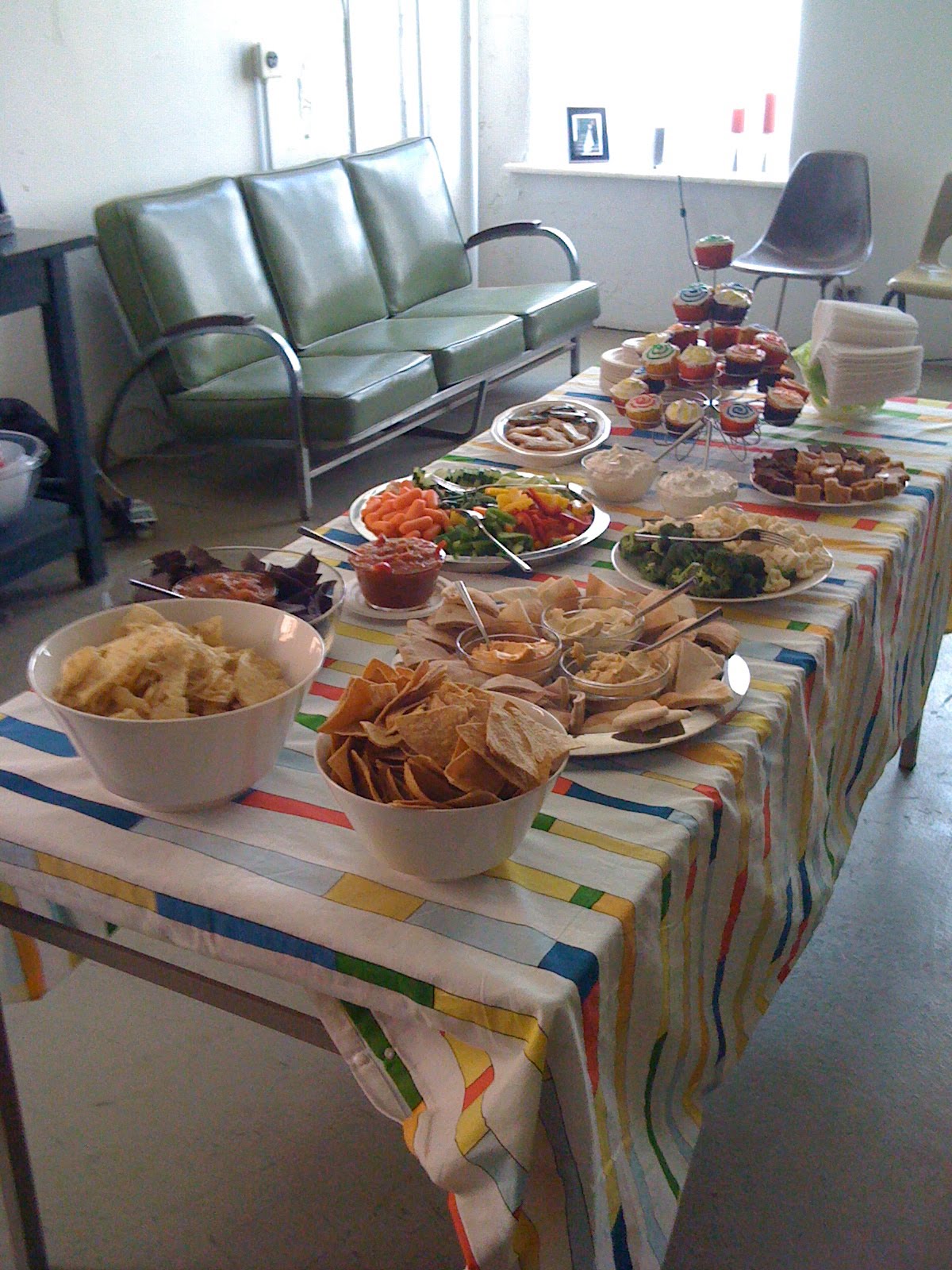
In honor of our son’s first birthday, we hosted an open house. We used a loose disguise theme, since Izzy loves hats and glasses.

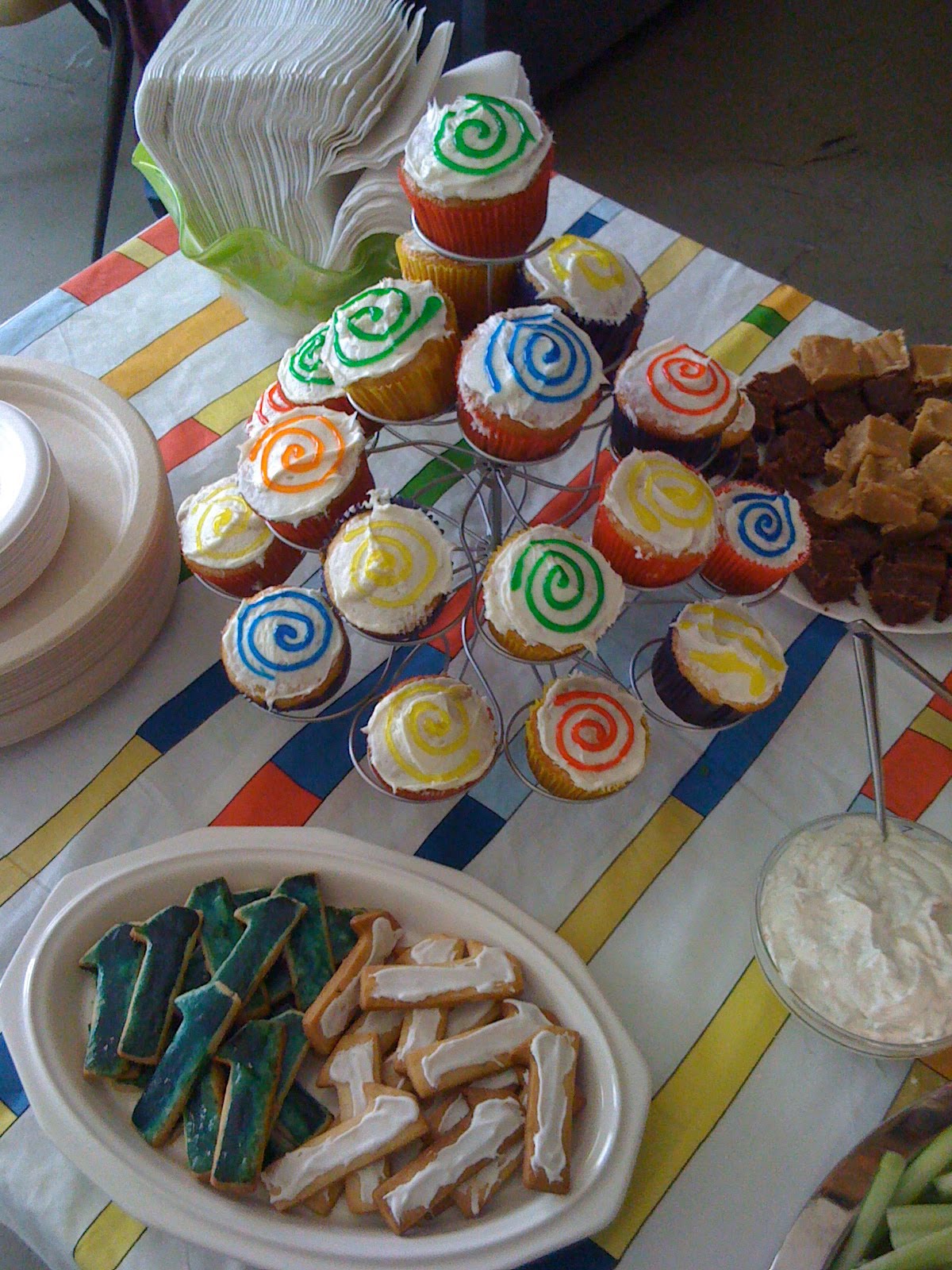
We kept our food simple: lots of healthy snacks and a few desserts.

I made about a million cupcakes and my grandmother’s butter cookies in the shape of the number “1.”


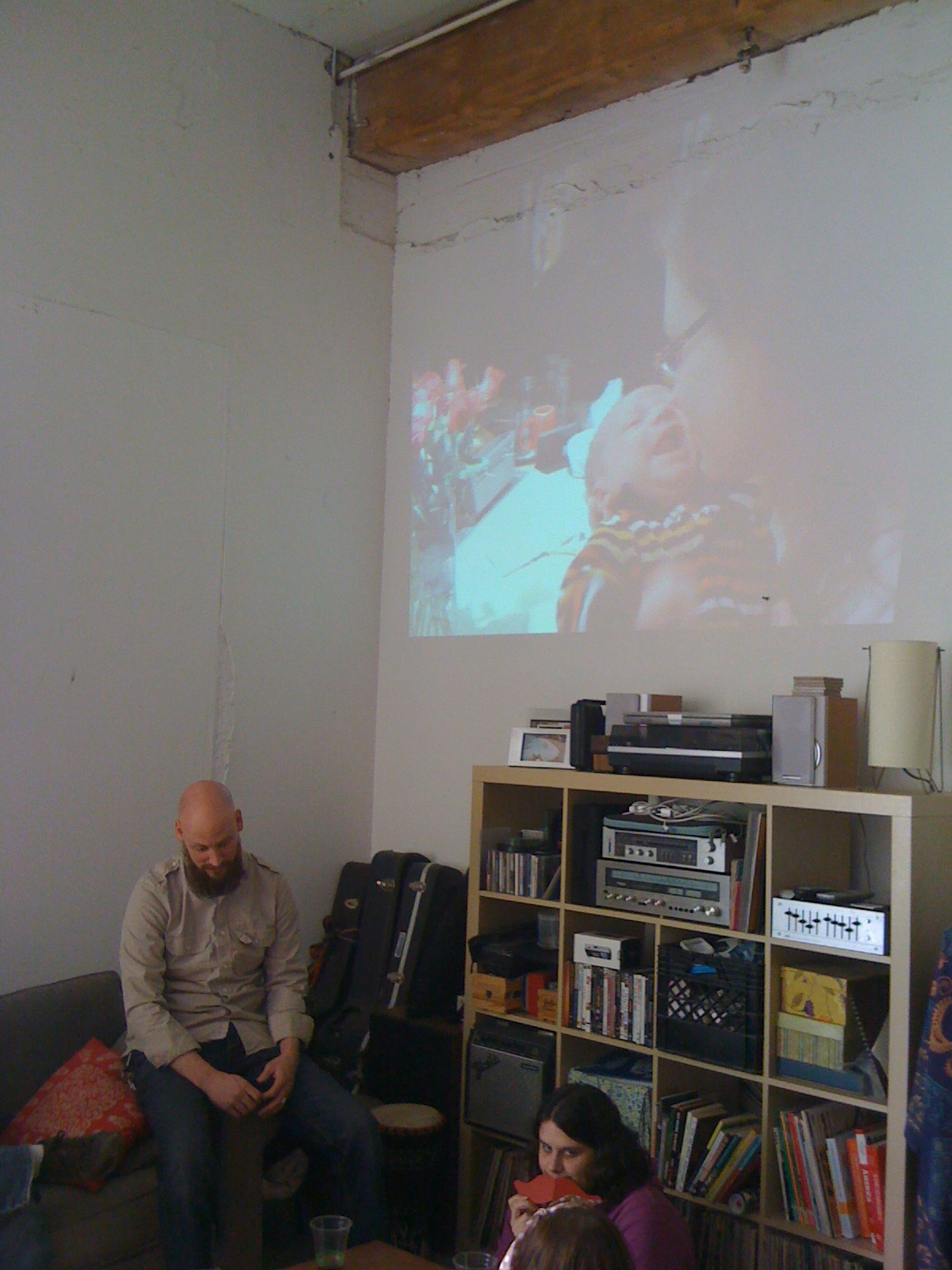
We took advantage of our high ceilings and projected a slideshow of our favorite photos of Izzy’s first year. It looped during the entire party.

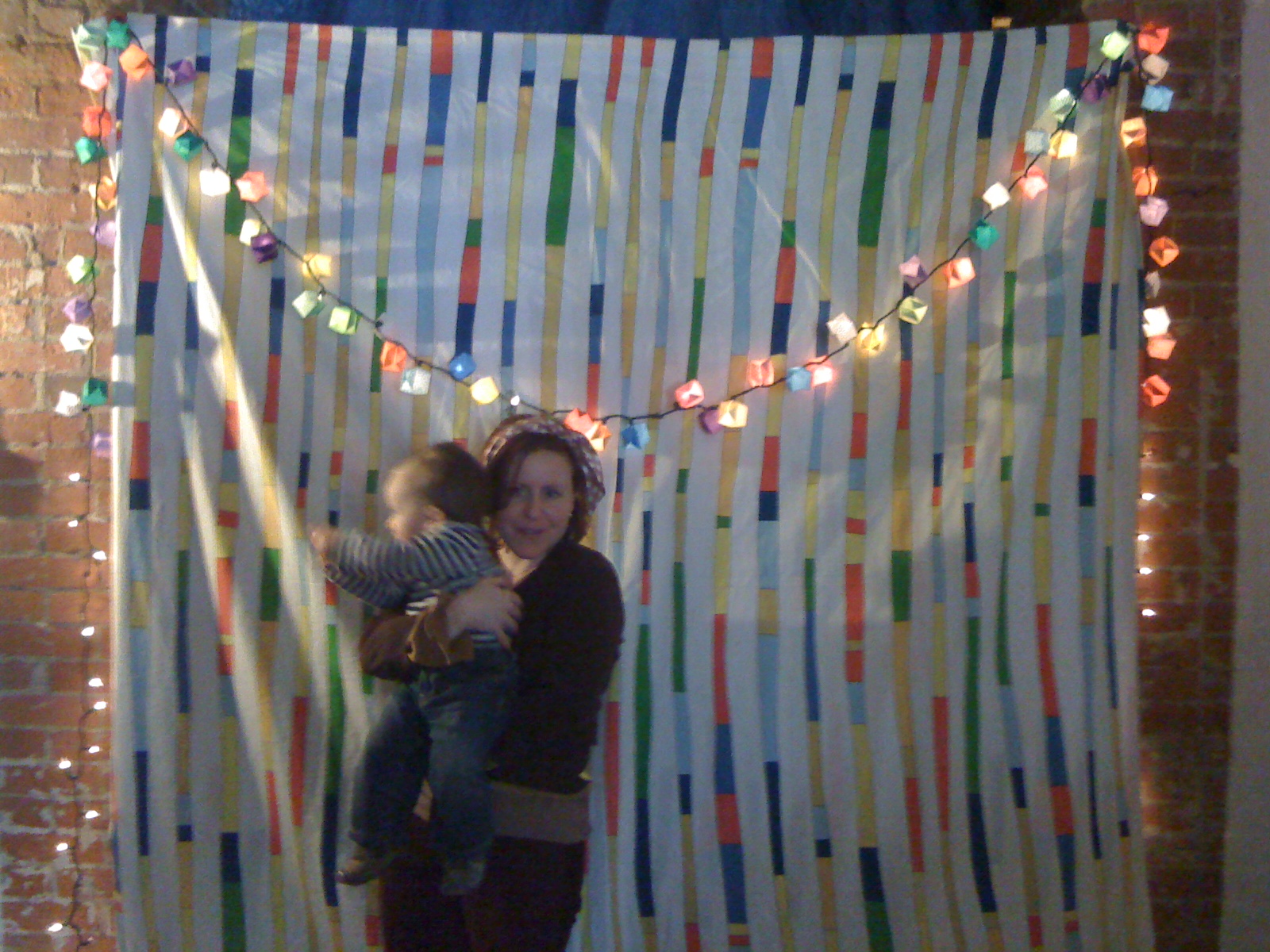
I made a hundred or so origami paper lanterns (and had extra paper and instructions ready for guests to make some, too) to decorate a make-shift “photo booth” to catch friends in their disguises. Sad to say, the natural lighting in our apartment is terrible and so very few photos came out well.

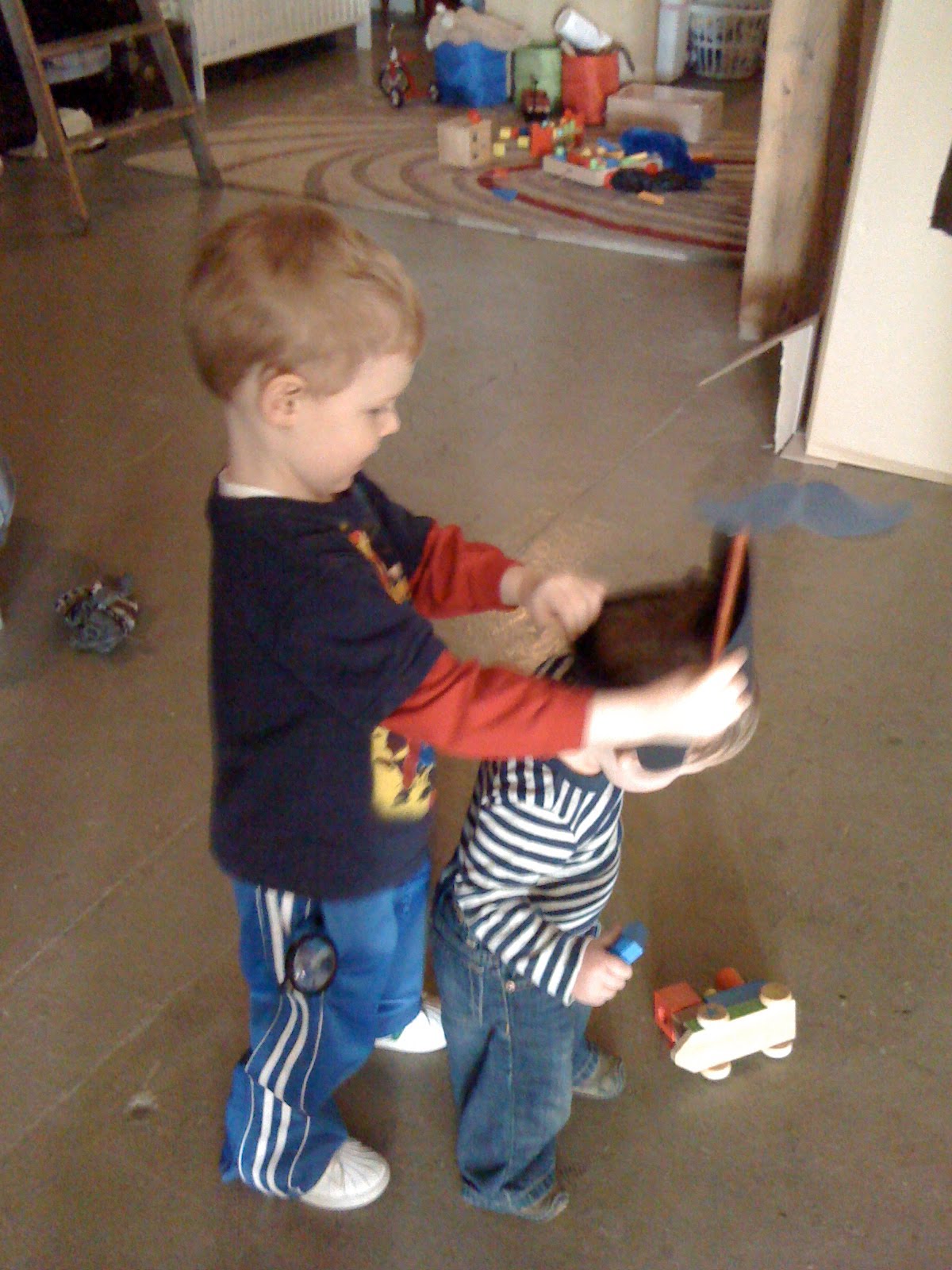
I made Izzy a paper hat and mustache for his disguise. He didn’t like it so much, but his cousin did and kept trying to get him to wear it.

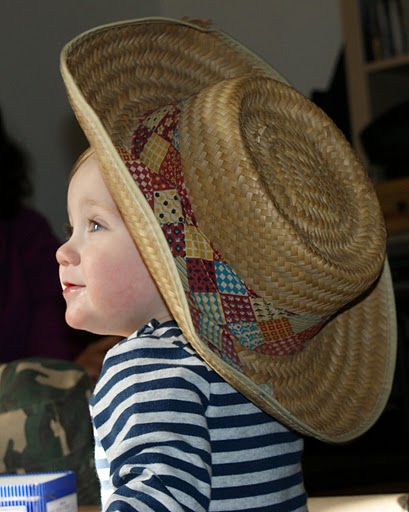
He liked this hat a little bit more.

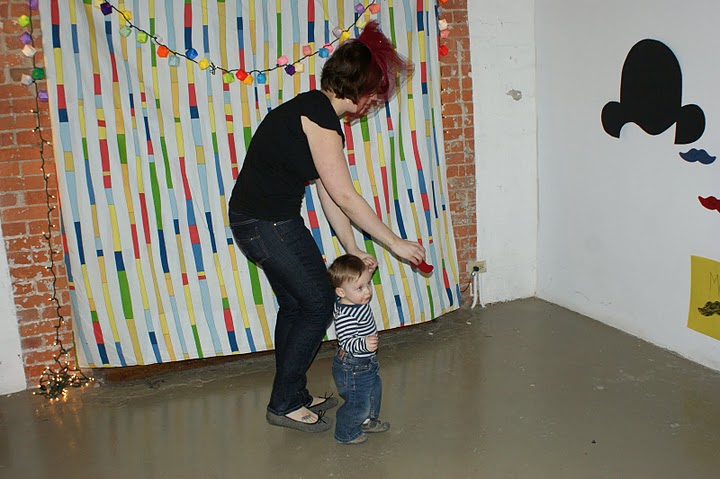
We played a rousing game of “Pin the Mustache on the Man.”

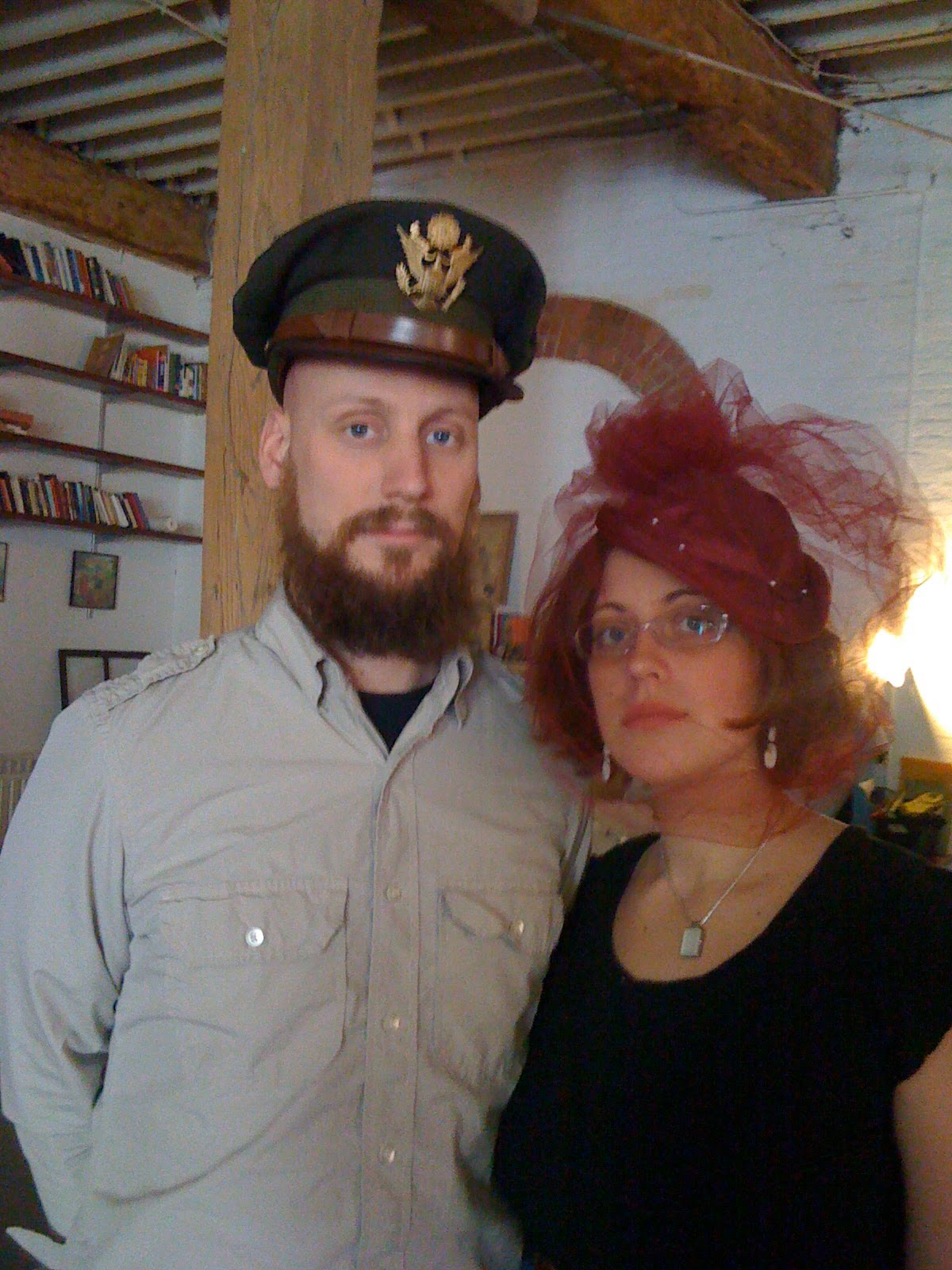
The host and hostess.

Happy first birthday to our sweet little boy!

Getting Around: Babywearing

Babywearing: It’s not just for hippies anymore, my friends.

Case in point:
My parents were in town last weekend for my son’s first birthday and I took them over to Findlay Market to buy some last-minute items for the party. Because the market is only three blocks away, I asked my parents if they’d be willing to walk, rather than drive. “I do it all the time,” I assured them. (Walking to the market may seem like second-nature to me, but this was a stretch for my parents.) They agreed and then my mom asked, “So, do you usually just bring Izzy in the stroller?”

No.
I “wear” him.

The act of carrying a baby in a sling is probably as old as the human race, and is seen in cultures worldwide. In recent decades, the Western world has re-adopted babywearing as one natural extension of a more hands-on, intuitive parenting than was popularized in the first half of the 20th Century. It’s also one expression of a mother’s decision to maintain close contact with her infant and breastfeed on-demand. This is perhaps why the word “babywearing” usually conjures images of Whole Foods Market and PETA rallies and why I seldom use the term. I am, after all, only about 30% crunchy and only prescribe to some of the attachment parenting philosophy, so I’m not the prime candidate for the label “babywearer.”

For me, wearing my child is less an issue of parenting philosophy and more an issue of practicality. A trip to Findlay Market is a great example of a time when babywearing comes in handy and makes more sense then contemporary methods of child transport (strollers, carrying, etc.). At a busy, open-air market, the aisles are small and crowded, you must be able to move quickly, it’s helpful to have two hands free, and (especially when you live within walking distance) it makes more sense to just walk the few blocks and not fuss with car seats, parking spaces, and strollers.

Another case in point:
Nine days after my son was born, I had been holed-up in my apartment for almost an entire week and was desperate to get outside. It had been very cold the past few weeks, but this particular day was sunny and warm and perfect for a brisk walk. I had not yet purchased a stroller and I was not interested in loading and unloading my son into the car. So, I took the opportunity to test out my new Hotslings baby carrier and carried my baby down to the library, out for a cup of coffee, and then back home. My newborn baby stayed nice and cozy next to my body and slept the entire time, waking up only for a quick breastfeeding break at the library.

After the initial newborn stage, my son and I had a difficult time figuring out how to use the sling as he grew too large to lay horizontal, but wasn’t yet strong enough to sit upright. A few months later, though, we were right back on the babywearing wagon and have been since.

Buying a Christmas tree at 10.5 months old.

I simply believe that, apart from any physiological or psychological benefits (for which there are many valid arguments), babywearing is simply an easy and practical way to transport a small child when traveling on foot, either for a short time (while shopping, waiting for a bus, waiting in line, etc.) or a long time (running errands on foot, hiking, cleaning house, etc.). In some instances, it is actually much easier than a standard stroller, is much cheaper, and much more portable.

In my opinion, smart mothers practice the art of babywearing from birth with their newborns so that the skill is always available when needed as their children grow older. It’s up to their discretion how often and for how long they use this time-old “trick” for carrying and comforting a child, but it’s a skill that is perfectly practical for any mother who does anything other than sit on the couch all day.

So, if you want to do your friend a favor as she’s expecting a baby, you can help her purchase that super hip stroller she’s been eyeing, but you should also help her pick out a baby carrier. It will help her feel close to her baby, make sure she gets out of the house and stays active, and make her competent to take care of both her baby and herself.

If you’re new to babywearing, there’s an entire culture to help get you acclimated. And there are tons of products, for those who are interested, that run the gamut from standard, to boutique, and then just plain ridiculous. (And that’s only the begining.) You can also find books about the subject, help guides for each different carrier, and join local groups for parents who practice babywearing.

I choose to keep it simple but, heck, you can get in as deep as you’d like!

Local Issues: The Enquirer Calls "Save OTR"

Cincinnati Enquirer Editor Tom Callinan published an essay last Thursday titled Now, not soon, is the time to save OTR’s historic treasures.

You need to read it.

You can find it
here.

An excerpt:

Soon is not good enough, Cincinnati.

Now would be a good time to get serious about saving Over-the-Rhine.

And I am not talking about crime there. I’m talking about saving its soul – the building stock that makes it one of the largest urban historic districts in the United States. The crimes are occurring not in the streets, but towering over them.

We are losing a treasure, one building at a time. That is the biggest crime happening in our midst…

Preservation of the historic core is not just council’s job.

It is not about them; it is us.

It is not there; it is here.

It is not soon.

It is now. – Tom Callinan

My question:

There are many of us who believe so fully in the value of Over-the-Rhine that we would be willing to invest the next 5, 10, 15+ years of our lives in helping save our neighborhood.

But, we aren’t necessarily the ones with the capital to make it happen.

Who will help us help OTR?

City Living: How Small is Too Small?

photo courtesy of bubbleinfo.com

A while back, the LA Times ran an article about a couple that was living in a 380 sq. foot home in the LA area and I saw it passed around various online sites and communities. Check out the original article here, or Apartment Therapy’s Ohdeedoh coverage here.

The article raised a lot of questions for me.

First of all, is it really necessary that my husband, son, and I share over 2000 square feet of living space?

Second, when we finally purchase or build a home, what sort of square footage is reasonable for our family?

Third, why do we have so much STUFF!?

I have not always lived in large spaces.
Although my family home was large while I was growing up, my parents downsized drastically when I went away to college and I’ve lived in mostly small spaces since. College dorms, my first apartment, and my first Cincinnati apartment were all small and required a lot of creative organizing and storage solutions. (Unlike many of my friends, I wasn’t able to store my things at my parents’ house for the years I was at college and afteward; I had to find a way to either take everything with me or get rid of it.) The apartment I’m in now is really the first place where I can stretch out, put things away, and still have space to spare. It’s glorious!

But.
Is it really necessary?
Yes.
And no.

I’ve thought a lot before about small living spaces and have always been fascinated by the miracles that modern design can work in a small living space, even for families with multiple children. Japanese design has been doing this for centuries. And, In some ways, I covet both this simple lifestyle and its aesthetic. The absence of possessions is attractive and the use of space is brilliant. Simple, clean, and uncluttered.

But, like the home featured in the LA Times and those I’ve seen here, here, and here, I’ve come to the conclusion that, though small has its perks, small is not always better.

Some thoughts:

– Families like the one living in LA have the availability of an outdoor living space that offers both an escape from the home and a place for their child to play. Without that space, I would presume that the indoor space would feel more restrictive.

– Well-designed small homes with multi-use spaces and creative organizing often require money and design expertise. If not, it’s hard to make a small home look anything but cluttered. Am I the only one who wonders if some of these folks have storage outside of the home, perhaps in a garage, basement, or another facility? Where do they store their Christmas ornaments!

– Okay, I know that the Christmas ornament question is silly, but it brings up a good point. Although I think purging useless junk is a great idea and something we can all learn to do, there is a certain charm to things like family keepsakes, childhood memorabilia, and heirlooms that seem absent in a lot of super-small living spaces. I’m probably one of the least sentimental people on the planet, but I still can’t imagine throwing out my high school photos. I know, I’m probably being foolish…

– In a super-small home, entertaining is often out of the question. My husband and I like having people over for dinner and I couldn’t help but notice that many families living in small spaces have teeny-tiny kitchens with no more than 4-6 tables settings. What if they want to invite another family over for dinner? Do they have to order takeout and ask their guests to bring their own flatware? I threw a 30-person dinner party for my husband’s 30th birthday this past year. Frankly, there was no way in hell I could have done that in a 38o square foot home.

– Lastly, I know that it’s really hip to have only one child (two at the most), but my husband and I hope to be more than a “family of four.” It’s easy to share a small space with an infant, but imagine doing that with four teenagers. Not so practical. A big family, to a certain extent, necessitates a bit of privacy. I’m not suggesting something extravagant, but a little space is nice. Maybe a few doors to close?

So, how small is too small for you?
For your family?
What would you have to give up to live in 380 square feet?