Local Issues: The Enquirer Calls "Save OTR"

Cincinnati Enquirer Editor Tom Callinan published an essay last Thursday titled Now, not soon, is the time to save OTR’s historic treasures.

You need to read it.

You can find it
here.

An excerpt:

Soon is not good enough, Cincinnati.

Now would be a good time to get serious about saving Over-the-Rhine.

And I am not talking about crime there. I’m talking about saving its soul – the building stock that makes it one of the largest urban historic districts in the United States. The crimes are occurring not in the streets, but towering over them.

We are losing a treasure, one building at a time. That is the biggest crime happening in our midst…

Preservation of the historic core is not just council’s job.

It is not about them; it is us.

It is not there; it is here.

It is not soon.

It is now. – Tom Callinan

My question:

There are many of us who believe so fully in the value of Over-the-Rhine that we would be willing to invest the next 5, 10, 15+ years of our lives in helping save our neighborhood.

But, we aren’t necessarily the ones with the capital to make it happen.

Who will help us help OTR?

Local Issues: Raising Kids in a Lead-Contaminated City

According to a news article from 29 Dec, 2009:

Ninety-three percent of the city’s housing stock was built before 1979, before lead was banned from paint. If the paint is intact, it does not pose a problem. However, when the paint chips and peels due to poor maintenance, dangerous toxins are exposed. Young children are particular susceptible because they touch the floor and windowsills, ingesting the poison, which can cause developmental and cognitive delays. (Read the complete article here.)

My husband and I live in a loft apartment in Cincinnati’s historic Over-the-Rhine neighborhood in a building that was once a brewery. In many ways, the apartment is a dream: we have 15ft. ceilings, concrete floors, over 2000 sq/ft of open living space, and pay pennies per square foot compared to other folks in our city. In other ways, though, this apartment is a nightmare: it’s impossible to properly heat, the landlord neglects normal maintenance issues in the units and the building, and my husband has had to invest his own time and energy into the most basic of improvements on our place. It’s a trade-off. We get a ton of space for cheap, but we have to work to make it comfortable.

When our son was born, we considered leaving, but also made a plan for the work we’d need to do on our apartment if we stayed. Insulating the back of the apartment and building bedrooms in that section, closing/insulating the ceiling, painting the floor, and rebuilding the bathroom were all on the list. Frankly, the past year has gone by too quickly and we’ve been too tired to do all that work ourselves (not to mention unwilling to foot the bill).

The one issue, though, that keeps haunting us is the open ceiling, which is basically just the floorboards of the unit above us. Not only does it mean there is no sound barrier between us and our neighbors, but that everything from water spilt on the floor above to the everyday dust from walking has the potential to end up in our apartment. Needless to say, keeping our floor clean is like conquering Goliath. As soon as our son started crawling, the open ceiling and the dust the results became our primary concern. This brings me back to the issue of lead contamination.

At my son’s nine-month doctor’s visit, he was subject to a routine blood test to check for lead contamination in his blood. As any mother would be, I was happy to comply and, as any mother living in the City of Cincinnati should be, I was anxious to hear the results. Knowing that my apartment is A) built long before 1979 and B) owned by a man who is not particularly interested in making improvements left me concerned that not only the paint on our walls but also the everyday dust on the floor could be poison for my son.

A month later, I got a very calm and courteous voicemail message from a nurse named Donna:

“Ms McEwan, I’m calling about the lead test results for your son. First of all, I would like you to know that he is NOT lead poisoned, but the test did show signs of lead contamination in his blood and I’d like to speak with you about it.”

The next week involved a lot of phone calls, internet searches, panicky floor cleanings and “what if” conversations with my husband until we were able to have our home visit from the nurse and discuss the issue of lead in general and our apartment and baby specifically.

To make a long story short, my son’s lead contamination level at the time of the test was 8.3 migrograms per decileter of blood. A level of 10 is considered “poisoned,” and the City can do very little to help us unless my son has been poisoned (i.e. enforcing lead abatement laws with my landlord, inspecting my apartment to pinpoint the contamination). Thanks to the help of the nurse who visited us and took a sample, we know that the paint on our walls is not lead paint and so we can assume the paint dust falling from the ceiling is not contaminated either (since they appear to be a result of the same paint job). Because that was our assumed source of contamination, we’re totally stumped as to how our son could have ingested or inhaled the lead.

Some thoughts:

– The nurse told us that all the rehab work being done in OTR could be producing lead dust to such an extent that my son could have inhaled it. Could this have happened just walking up and down Vine St. in the past few months?

– I would assume our building has lead pipes somewhere down below. Although the pipes “should not” produce lead-contaminated water, what if they do? We’re going to purchase a cheap (and often unreliable) lead test to see.

– We’ve been very careful about the toys we’ve purchased for our son–where they’re made, what they’re made of, etc. But we’ve let some toys slip in from friends and family members. What if my son ingested lead from a cheap, foreign-made toy? We’re seriously considering getting rid of all of them, just in case.

– When asked to compare the severity of my son’s 8.3 lead level, the nurse said that a child can ingest one single lead-contaminated paint chip and their blood be poisoned to a level 20. So, there’s a chance that my son’s lead exposure was a one-time fluke that will soon be a memory.

So, until we get connected with the Lead Clinic at Children’s Hospital so our son can be watched closely for further exposure, my husband and I are playing detective to find the source and taking extra precautions to get our baby’s blood healthy (via extra iron and calcium and lots of hand-washing).

I’m curious if any other folks out there have had experience with lead abatement in your buildings or a lead scare with your own children.
Thoughts?
Ideas about the source?

Another point of interest: There are all sorts of theories and rumors around the environmental health world that suggest lead poisoning (and not poor parenting, education, or culture) as the primary explanation for the high presence developmental delays, ADD, and behavioral problems in poor urban youth. This theory holds weight, I believe, if you consider that many families in cities live in rental properties and not family-owned homes, do not have the financial means to abate their own living spaces, and may not have the education to know the dangers of lead and how to prevent lead poisoning in children.

For further information about lead poisoning, visit the Children’s Hospital website or read this Wikipedia article.

Do This: Shop local for Christmas gifts!

Because we all know that local is always better, I’d like to share my favorite places in Cincinnati for purchasing gifts:

(in no particular order)

Park + Vine– Cincinnati’s “green” general store. Purchase locally handmade and recycled goods, eco-friendly baby/kids’ stuff, pure and natural homegoods and toiletries, locally-themed shirts and bags. You’ll find rainbarrels and clothes drying racks a-plenty and the word on the street is that the whole store is vegan.

Ten Thousand Villages– You’ll find fairly-traded handmade goods from artisans around the world. Though it’s not a locally-based organization, one of their retail shops is in O’Bryonville. My favorite item? The Christmas decorations and toys!

The Ohio Bookstore– With five floors of used books, you can find something for every book lover. (Check out the collections in the glass display cases on the street-level floor!) I’ve been meaning to have a book or two of my husband’s re-bound in their bookbinding shop…

Shake-It Records– I don’t go to Shake-It for the music; I go for the (seemingly) endless shelves of designer toys, magazines and ‘zines, books, graphic novels & comics, and other assorted “won’t find anywhere else in town” items. Wind-up sushi–need I say more?

The Blue Manatee– The kind of bookstore that makes me want to be a kid again…

Market Wines
at Findlay Market- Nothing goes better with a holiday meal catered by the Market than a fancy-pants bottle of wine. The folks at Market Wines will help find the perfect bottle for your dinner party or for a hostess gift. It’s so nice to talk to people that know a thing or two about what they’re selling!

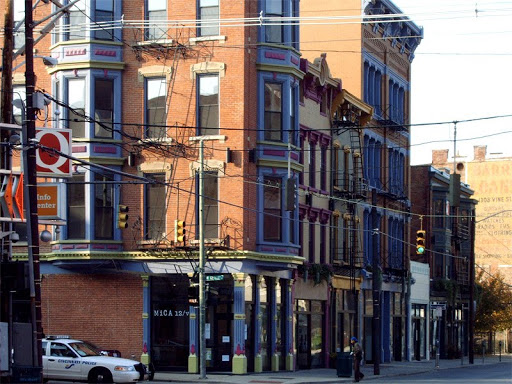
Mica 12/V– Mica never fails to deliver the perfect gift for my mother–the woman who has everything: something shiny, well-made, distinct, and original. I usually have to keep it small (the place isn’t cheap), but I can always find something great in my price range. (To top it off, they carry various pieces by local artists Visualingual, who probably deserved a spot of their own on my “favorites” list.)

Duck Creek Antique Mall
– I bought most of my bridesmaids’ gifts at Duck Creek, and intend to make it there sometime in the next few days for last-minute Christmas shopping. My favorite finds? Mid-Century Modern furniture, vintage children’s toys, and fancy ladies’ pocket mirrors.

So, if you’re like me and just realized that Christmas is *gasp* less than a week away and you’ve neglected to start your Christmas shopping, skip the corporate chains and keep it local.

Does your sister really need another sweater from the GAP?
Seriously.

Local Issues: 3CDC, Gentrification, Mixed Feelings…

I know this might be a tired issue to some, but I’ve been re-thinking my position on 3CDC‘s development of Over-the-Rhine–the “Gateway Quarter.”

(photo courtesy of Rustwire.com)

Among those concerned with the welfare of Cincinnati’s urban core and its residents, there has been a lot of talk of the ills/benefits of gentrification, the implications of a rising cost of living in Over-the-Rhine (OTR) and the Central Business District (CBD), and what the displacement of the characteristically urban residents means for the surrounding areas (CUF, Mt. Auburn, the West End, etc.). In the past few years, I have gone back and forth about 3CDC, its takeover of the neighborhood, and its methods of achieving (what appear to be) great development goals. I don’t want to get too personal here, since I’m still new to the Cincinnati blogging community and I’m not quite ready to make enemies, but I do want to share some thoughts on a few specific issues.

The “socially-conscious” side of me is very sympathetic to those who may be displaced from their current homes because they (like myself) may not be able to survive the rising rent costs. I understand how it feels to have a strict budget, one that can’t lend itself to an extra $200 a month in rent. And now that my husband and I are beginning the search for our first house, we understand how difficult it is to find a single-family home that is safe, affordable and where the amenities of an urban life are still accessible. Because we believe in the inherent value of having a large family, yet we are not a part of the upper-class, we may never have the expendable income necessary to adapt to living in an up-and-coming neighborhood. (I’ve had to reconcile that my life will probably never resemble the Huxtables’. Bummer, right?) And, so, it does sadden me to think of all the families in much worse financially situation than us. It’s only a matter of time, I’m sure, before there are simply no options for the true “working poor,” and they will be forced to move out of OTR and the CBD in search of apartments with more than two bedrooms, for less than $1000 a month in rent.

I must admit, though, that my sympathy only reaches so far.

I know what sort of living conditions often come with “affordable rent,” and I know that poverty in an urban setting is inextricably bound to issues of blight and crime. So, although I am sympathetic to the family who will be displaced because of rising rent costs, I am not sympathetic to the drug dealer who used to sell on their doorstep but is now struggling in his new “market,” the absentee landlord who had (until now) refused to turn on their heat before December, and the owner of the (now closed) corner store a block away who made a good living selling malt liquour beverages that feed addictions and destroy lives. If keeping this hypothetical family in their home requires protecting the “rights” of those who also live in the neighborhood and who are victimizing the family every day, then I’m not certain which cause deserves more attention. Which is a greater quality of life issue: the right to poverty or the right to progress?

Along these lines, I appreciate what 3CDC has been able to do to improve the quality of life for residents in Over-the-Rhine and the surrounding area.

But, let’s take this a step further.
I believe that economic development would, in a perfect world, benefit not only those with the resources to facilitate the development, but also those who currently reside in the area being developed. The goal, then, is not to develop an area in a way such that people are forced to leave, but in such a way that they are allowed to develop and grow with the neighborhood. So, a truly benevolent investor would pour his/her money into the community in such a way that makes accessible the education, jobs, and resources that will make the people–not just the buildings–better. The catch is that people, unlike buildings, cannot be forcibly altered. And for every family that would like to progress toward purchasing a quality home and will work hard to maintain its quality (for the benefit of the whole neighborhood), there is another that is too loyal to the current regime of the neighborhood to allow themselves to participate in the progress. The same goes for business owners: some current business owners deserve to stay while others, I am bold to say, do not.

Then, on top of the actual ideological issue of gentrification, we could add the questions of economics (What exactly is “poverty” and what should be considered a reasonable cost of living for a thriving neighborhood?), culture (Who decides which cultural expressions/institutions should remain as an area develops?), and praxis (Who should design the development, what should it look like, who should be contracted to do the work, etc.?), but I don’t want to get into those now.

At the end of the day, I still have mixed feelings about gentrification in general and Cincinnati’s current urban renaissance specifically (a la 3CDC, Urban Sites, and others). I suppose that, like most things, we will have to judge the revitalization of Over-the-Rhine on a building-by-building, case-by-case basis; We can talk about gentrification, ideologically, until we’re blue in the face and never actual address any real issues.

On that note, there are two specific criticisms of 3CDC that I’d like to express, before I retire the issue altogether.

First.
Was it really necessary to close both sides of the sidewalk on Vine St. at the same time?
I understand that streetscape projects like planting and concrete work require proper timing and weather conditions, but a little common sense would have told the developers to do one side at a time! There are tons of folks who walk up and down Vine St. every day on their way to work, school, the grocery store, the bus stop, etc. and it’s not only a major inconvenience, but it speaks volumes about the developer’s lack of regard for the people who already live in the neighborhood. Did anyone else notice this problem? I know I wasn’t the only one dodging traffic with a stroller the past few weeks!

Second.
I am thankful that much of the new development involves condo living, rather than rentals, but the actual living spaces themselves and the cost of living in them send another message to potential buyers: families are not welcome. I understand that it’s really fun and exciting to fill the neighborhood with uppity young professionals who will spend their nights sipping wine on the balcony and decide to have their first (and only) child at the age of 45 but, frankly, you cannot build a community with only these folks. A quick search on 3CDC’s website for units for sale with 2 or more “sleeping areas” yields only 28 options, most of them hovering around 1000 sq. feet and over $200k. The mortgage, together with the condo fees, parking fees, etc., would require (in my opinion) an income in the range of $60-80k a year, at least. Although many folks in Cincinnati may fall into this income bracket, why in their right mind would they choose to live in a 1000 square foot condo where the second “sleeping area” is actually a corner of the room with a privacy wall when they could just as well live in a 3 bedroom, 2000 square foot tudor in Pleasant Ridge on a .5 acre plot of land? And that doesn’t even take into account the families that need to live downtown because of the availability of public transport and employment opportunities and make closer to $30-50k (or less). They will be stuck in apartments forever.

I know that 3CDC is working the OTRCH to subsidize a few of the rowhouse properties they’re building. I don’t know, though, that this will even begin to solve the problem. What message does the subsidy send? It tells these potential homeowners that they can only have a decent, affordable home when it comes in the form of a handout. It says, “These homes are not for you, but we’ll let you live here.”
But, this is an issue for another time…

Thoughts?
Am I totally wrong here?
Do you have specific praises or critiques for urban revitalization here or elsewhere?
What’s your experience with gentrification?
(Note: unwarranted, cruel comments may be deleted)
Do This: Cincinnati Unchained!


I am a firm (very firm) believer in supporting local businesses.

BuyCincy, a blog that is dedicated to supporting the best of local business in the Cincinnati area, has organized an event called Cinicinnati Unchained. It takes place tomorrow (November 21) and is a great way to put your money where your mouth is in support of our local economy. View the complete information here.

(BTW: Does anyone else think it’s CRAZY that tomorrow is already November 21st? Geez!)

About Cincinnati and how I ended up here.

According to the source of all human knowledge (Wikipedia):

Cincinnati is a city in the U.S. state of Ohio and the county seat of Hamilton County. The municipality is located north of the Ohio River at the Ohio-Kentucky border. The population within city limits was 333,336 in 2008, making it the state’s third largest city. In 2008, the Cincinnati Metropolitan Area had a population of 2,155,137 making it the largest MSA in Ohio, and the 24th most populous in the United States. Residents of Cincinnati are called Cincinnatians.

Cincinnati is considered to have been the first American boomtown in the heart of the country in the early nineteenth century to rival the larger coastal cities in size and wealth. As the first major inland city in the country, it is sometimes thought of as the first purely American city, lacking the heavy European influence that was present on the east coast. However, by the end of the nineteenth century, Cincinnati’s growth had slowed considerably, and the city was surpassed in population by many other inland cities…

Cincinnati is also known for having one of the larger collections of nineteenth-century Italianate architecture in the U.S., primarily concentrated just north of Downtown in an area known as Over-the-Rhine. Over-the-Rhine is one of the largest historic districts listed on the National Register of Historic Places.

Read the full article here.

How did I end up Cincinnati?

I grew up in the near southwest suburbs of Chicago, in a small city called Palos Heights. I am a bonafide Midwesterner, with the first eighteen years of my life contained within the southern half of the Chicagoland area, and summers spent between our family’s small lake cottage in southwestern Michigan and a camp in the northwoods of Wisconsin. Until I was about sixteen years old and allowed brief day trips downtown with my brothers or friends, my experience of real urban life was limited to school field trips, visits with friends who lived nearer to the city, and the occasional family drive downtown.

I attended college at a small university in Elgin, IL, a city 40 miles west of Chicago and ten times the size of my hometown. Elgin is not exactly a booming metropolis, but it’s a city nonetheless. With it’s official population hovering around 100,000, off the record are the (I’m guessing) thousands of illegal immigrants and hundreds of homeless that live there. The city, at the time I lived there, was almost a Little Mexico, with just as many signs in Spanish as there are were English, and Cinco de Mayo was a hell of a party in town.

The summer before our senior year of college, two friends and I moved into a small loft on Chicago St. My bedroom was extremely cold in the winter, hot in the summer, and we could hear everything our downstairs neighbor did (and smell every drug he smoked). We were on the third floor, two stories above a tattoo shop, nextdoor to the YWCA, two doors from the public parking garage (where we parked), and a few blocks from the public library. Our favorite bar–The Gasthaus–was three blocks away, my bank was on the corner, Akina’s was a few blocks away if we wanted Thai food, and so was Al’s Cafe (for sandwiches and milkshakes). We walked down to Cafe Magdelina for wine and creme brulee, and I rode my bike to the grocery store (where half the signs were in Spanish) for groceries. I bought fresh cookies at one of the local Mexican bakeries and I shopped for gifts at Keeney’s–the old-school sporting goods store with a treasure trove of vintage goods in the basement. I worked at a local coffee shop and rode my bike to summer classes. I took the train–from the station on the river–to Chicago.

Elgin may not be a booming metropolis, but I loved it there.
After growing up in a neighborhood where the more urban areas 10 miles away were considered “dangerous,” Elgin liberated me of my suburban bias. I experienced what much of the rest of the world experiences–loud streets, street parking, public transportation, homeless neighbors, etc.

In the summer of 2005, in an effort to sustain a oft-wavering relationship (that ultimately failed), I moved to Cincinnati. My first apartment was a tiny, 2-room, studio in the back of a house. In the unit next door lived another local musician. I had a separate entrance with a little patio and a plum tree outside my window. I slept on a loft built into the corner of the living room, and survived the misery of my first hot, humid Cincinnati summer without A/C. The apartment was in the Northside neighborhood of the city and I lived a block off of the main street, where I could find just about anything I needed–veggies, beer, ice cream, breakfast, an indie flick, records, or vintage clothes. I think the only thing Northside doesn’t have is a full-service grocery store, but one of the best ones in the city is only a 5 minute drive away.

After a year in Northside, I moved to Norwood to live with some friends in the same neighborhood as our church community. I lived there–without the amenities of a hip, urban life but surrounded by the same urban blight–for almost two years.

Then I got myself married and moved to Over-the-Rhine.

My husband and I are now almost a year and a half into our marriage and almost 8 months into parenthood. We rent a large loft apartment north of Liberty St., in a part of OTR that hasn’t yet been gifted with the development that our neighbors below Liberty have. In the next year, we hope to purchase our first house. For now, we invest a lot of time and energy in improving our apartment in whatever ways we can, for as little as we can, so that the hostility of the neighborhood doesn’t seep into our home.

The city is a difficult place to live.
I am the first to admit this.

My husband and I sometimes dream of a rural homestead, a place where our family can have some privacy, peace & quiet, and be surrounding by natural spaces instead of concrete. And we often admit to each other that the suburbs have a certain charm–clean sidewalks, backyards, and friendly neighbors. But we have, at least for the time being, committed to living as near downtown as possible. We believe that the city needs families and that families need each other, so we’ve put ourselves in a position to be a part of a renaissance that calls families back to our urban core. I can’t guarantee how long our time in Cincinnati will last, but for the time I’m here, I have chosen to dive head-first into my new hometown.

I want to share the wonderful things I’ve discovered about my city and the life that cities in general offer. Maybe I can paint a picture of city living the way it’s supposed to be–vibrant, creative, friendly, and POSSIBLE–so that someday, I can call you my neighbor.

Thanks for reading!