My husband is trying to convince me to move out of downtown into a nearby neighborhood. (Don’t worry, we haven’t jumped ship yet, but I am patiently hearing him out.) There’s a lot that goes into this discussion–some current issues with our apartment, plans for a family business, housing co-op ideas, etc. One main concern that both of us share: if we stay downtown, where will our son play?
I’ve been thinking a lot about outdoor play places and an experience last week solidified some things for me.
A friend of ours held their daughter’s fourth birthday party at a play equipment manufacturer’s warehouse out in one of Cincinnati’s east suburbs. This company opens their warehouse/showroom to the public for open play and to rent for parties. All of their display pieces are fair game, everything from trampolines, blow-up bouncy castles, play structures, and basketball hoops. It’s a brilliant idea and it was an awesome party. Thankfully, my son can walk and climb, so there were a few things he could play on (including swings–which he loves), but most of the play structures are optimized at an older age. One structure was super cool. It was three full stories, connected by ladders, kept secure with vertical bars, and featuring a three-story winding slide. The price tag read: $35,000.
Yep, $35k.
This led me to ask myself: If I had $35,000 to spend on a play structure for my children, how would I spend it? And I’ll tell you what–the last thing I’d spend it on is a mass-produced, bright blue steel structure for my backyard.
Now, let’s put this into a public space perspective.
Most conversations surrounding public playscapes focus on two main issues: safety and durability. Basically, “How can we keep our kids busy without hurting them? Oh! And we don’t want to have to replace anything in a year or two.” Now, I understand that both safety and durability are important questions to ask. But, are they the only questions we should be asking? And are they the most important?
What did kids do before steel play structures were invented?
Geez! They must have been bored out of their minds, right?
Think about your average urban (or suburban) public play area.

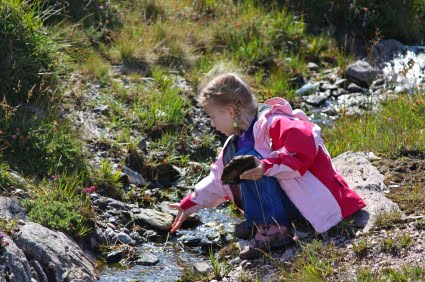
Now, think about the childhood experience of outdoor play in a natural area.

Think about the materials, the shapes, the colors, and the textures. Compare the freedom and curiosity that come alive in natural spaces to the strictures and literal play of manufactured play areas. Sure, these play places keep kids busy and relatively “safe,” but the kids aren’t learning anything, exploring anything, and definitely aren’t creating anything. Instead, they run around in circles inside a fence, climb up and down and up and down the same ladder, and swing back and forth on swings. Geez, even video games require some sort of strategy!
I would venture to say that most public play areas are a terrible waste of space and resources because they bear such little resemblance to natural areas.
Believe me, I know that the solution for most of us does not involve abandoning public play spaces because it’s unrealistic to expect that those of us in urban areas should drive to the nearest wooded area whenever our child wants to play ouside. Instead, I wonder what would happen if we reconsidered the way we design and structure our public playscapes. This wouldn’t satisfy the entire problem–we still need to expose our children to natural spaces–but it would satisfy the day-to-day need for children to play in ways that make them stronger, smarter, and more creative, rather than simply occupied.
What if we designed our urban play areas to more closely resemble natural areas?
And what if, instead of buying a $35,000 play structure for a public park, we hired a landscape architect or naturalist to create a public greenspace area that encouraged natural play and activities?
I’ve found a lot of great resources online for just this sort of idea, and there are other cities and countries that are already doing this (or have been doing it for decades). When I get the time, I hope to post some links to articles, photos, and other great resources.
For now, I’m curious what you think about the average (sub)urban play area and how it compares to your experiences of play as a child.
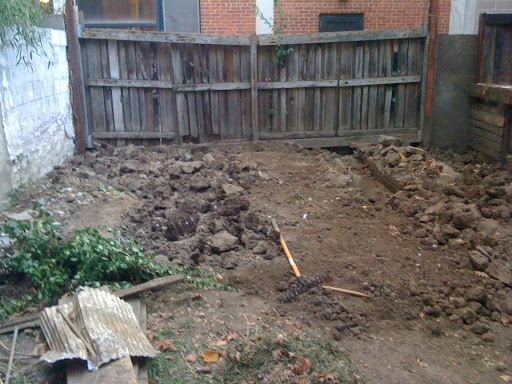 After raised-bed planters were removed.
 The steel, aluminum, and wood we tore out.
 Pavers we dug out of the ground. Saved to re-use.





 the walking green