Getting Around: Baby-Friendly Biking

Although I’ve never been a “serious biker,” I have enjoyed periods of my life when I commuted either to school, to work, or on errands by bicycle. Here in Cincinnati, the downtown business district is easily navigable by bicycle (although the area surrounding downtown is riddled with hills that, I’ll admit, I have dared not climb).

I would like to resurrect the bike-riding part of myself, but there is one problem: a nine-month old baby.

I’ve been told that I’m crazy to think of letting my baby anywhere near my bicycle, let alone let him ride along with me. Still, I can’t help but fantasize about strapping him in a little bike seat and pedaling down the block for a cup of coffee or to the library–it seems a bit more efficient than walking with a stroller. Heck! I could pedal that thing clear across the river if I wanted to!

In many other parts of the world, family bicycling is not only acceptable, but it’s perfectly normal. A quick Google search online yields an amazing array of family bikes, some homemade from unlikely and *gasp* possibly unsafe materials and others fancy, special-order types that cost as much as a cheap car. I’m interested in what other people have discovered as the best option for commuting by bike with a child who is too young to pedal along.

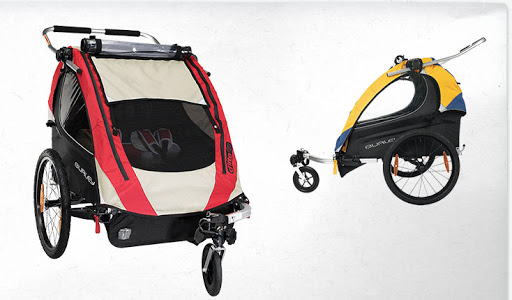
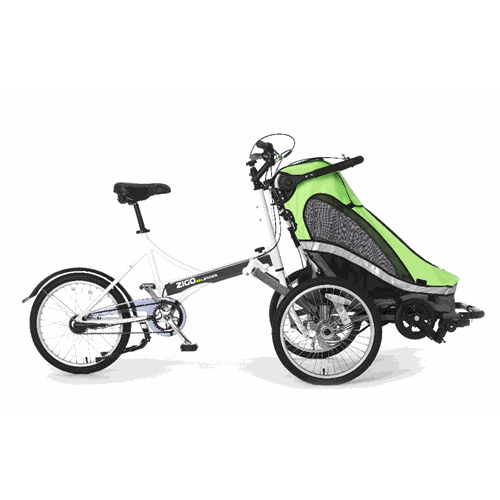
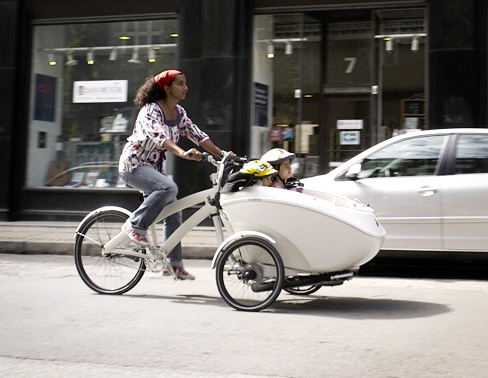
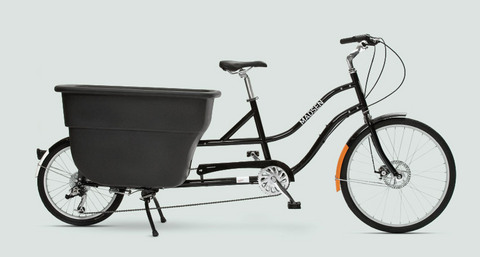
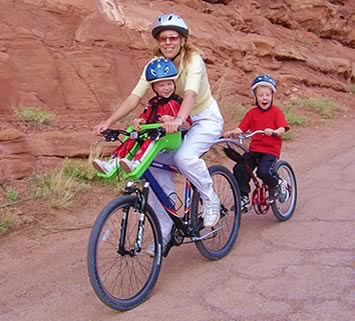
Have you seen or used any of the products pictured below?
Do you “serious” riders have any suggestions for those of us who are ready to get back on a bike?

Most of us are familiar with traditional rear-mounted bike seats, but I’ve recently discovered the front-mounted variety which seem to make a lot more sense to me: the iBert Safe-T-Seat

Another familiar product, I grew up riding behind my father in something similar to this trailer (although I think my dad made ours himself): the Burley d’lite ST

This is a front-mounted spin on the traditional rear-mount trailer: the Zigo Leader

And a cooler version of the front-mount trailer: the trioBike

And what is, perhaps, my favorite family bike option from what I’ve seen: the Madsen Bucket

One question, though: If I saved my pennies to buy the Madsen Bucket cycle, where would I park the darn thing? Do you think it requires a parking space? Geez

Until I can figure out where my son and I fit into the bicycling world, I fully support making our city more bike-friendly and I try to do my part to drive with cyclists in mind. Ride on, my friends. Ride on.

Go Play Outside!

My son’s generation (and possibly mine before his) has a problem: kids just don’t play outside anymore.

Either they have no place to play (no public greenspace, no accessible virgin or natural spaces, fenced backyards), they aren’t allowed to play (it’s too dangerous–whether realistic or imagined), or they have simply forgotten how to make their own play (their natural creativity has been dulled by contemporary toys and play-places).

Richard Louv
, author of Last Child in the Woods, coined the term “Nature-Deficit Disorder” for this problem. I saw Louv speak at a conference a few years back, after his book was first published. At the time, I thought he was a bit long on diagnosis and short on cure, but I do think that his diagnosis is spot-on. (Though I could do without the hype surrounding this “disorder,” the book is good reading for anyone who is now or will ever be responsible for the life of a child.)

One evening, when my boys were younger, Matthew, then ten, looked at me from across a restaurant table and said quite seriously, Dad, how come it was more fun when you were a kid? – Richard Louv, Last Child in the Woods

This isn’t just an urban phenomenon, of course. It crosses all socio-economic boundaries and is just as prevalent in the city kids who have never been to a working farm as it is in the rich suburban kids who don’t know what grass looks like when it hasn’t been mowed lately. Unless you are intentional about the way you expose your children to the natural world, there’s a large chance they will grow to prefer an hour with the latest video game over a hike in the woods or a chance to watch a thunderstorm on the front porch.

I am not a fanatic; I do not believe the world is going to Hell in a hand basket because some kids can’t identify trees. I do, though, think we have a problem on our hands and it’s affecting our kids’ health, creativity, and the very depth of their experience of life.

My husband and I revisit this issue often: how can we give our city-raised, concrete-walking kids a love for nature?
Without a backyard or nearby forest for exploration, how can we guarantee that our children grow up with a basic understanding of natural science (something that was once considered basic human knowledge and a matter of survival) and the beauty of nature’s rhythms (which births a sense of awe and wonder)?

And while surrounded by urban crime and blight, how can we give our children the wellness and bravery that naturally rises from experiences in natural spaces?

More so, how can we cultivate their young, creative minds when all our neighborhood offers are restrictive city streets and plastic, pre-fab public parks as play places?

In the past five or ten years, with an eco-renaissance of sorts in popular culture, the tides are beginning to shift and parents are becoming more intentional about recapturing the wild, outdoor experiences that used to be the norm for all children. Although purists are skeptical of the popularity of “going green,” this popularity has benefits. Namely, the opportunities that were once reserved for “weird” and eccentric parents are now being embraced by soccer moms and public schools alike.

Because this issue is so dear to me, I want to make it a regular topic on The Walking Green. Every couple weeks I’ll be introducing an opportunity, local organization, place, person, etc. as a resource for families who care about providing these important outdoor experiences for their children or the children they care for. Let me know if there’s something that you believe deserves some attention and I’ll try to feature it!

In the meantime, shut down your computer, grab the kids, and go play outside!

About Cincinnati and how I ended up here.

According to the source of all human knowledge (Wikipedia):

Cincinnati is a city in the U.S. state of Ohio and the county seat of Hamilton County. The municipality is located north of the Ohio River at the Ohio-Kentucky border. The population within city limits was 333,336 in 2008, making it the state’s third largest city. In 2008, the Cincinnati Metropolitan Area had a population of 2,155,137 making it the largest MSA in Ohio, and the 24th most populous in the United States. Residents of Cincinnati are called Cincinnatians.

Cincinnati is considered to have been the first American boomtown in the heart of the country in the early nineteenth century to rival the larger coastal cities in size and wealth. As the first major inland city in the country, it is sometimes thought of as the first purely American city, lacking the heavy European influence that was present on the east coast. However, by the end of the nineteenth century, Cincinnati’s growth had slowed considerably, and the city was surpassed in population by many other inland cities…

Cincinnati is also known for having one of the larger collections of nineteenth-century Italianate architecture in the U.S., primarily concentrated just north of Downtown in an area known as Over-the-Rhine. Over-the-Rhine is one of the largest historic districts listed on the National Register of Historic Places.

Read the full article here.

How did I end up Cincinnati?

I grew up in the near southwest suburbs of Chicago, in a small city called Palos Heights. I am a bonafide Midwesterner, with the first eighteen years of my life contained within the southern half of the Chicagoland area, and summers spent between our family’s small lake cottage in southwestern Michigan and a camp in the northwoods of Wisconsin. Until I was about sixteen years old and allowed brief day trips downtown with my brothers or friends, my experience of real urban life was limited to school field trips, visits with friends who lived nearer to the city, and the occasional family drive downtown.

I attended college at a small university in Elgin, IL, a city 40 miles west of Chicago and ten times the size of my hometown. Elgin is not exactly a booming metropolis, but it’s a city nonetheless. With it’s official population hovering around 100,000, off the record are the (I’m guessing) thousands of illegal immigrants and hundreds of homeless that live there. The city, at the time I lived there, was almost a Little Mexico, with just as many signs in Spanish as there are were English, and Cinco de Mayo was a hell of a party in town.

The summer before our senior year of college, two friends and I moved into a small loft on Chicago St. My bedroom was extremely cold in the winter, hot in the summer, and we could hear everything our downstairs neighbor did (and smell every drug he smoked). We were on the third floor, two stories above a tattoo shop, nextdoor to the YWCA, two doors from the public parking garage (where we parked), and a few blocks from the public library. Our favorite bar–The Gasthaus–was three blocks away, my bank was on the corner, Akina’s was a few blocks away if we wanted Thai food, and so was Al’s Cafe (for sandwiches and milkshakes). We walked down to Cafe Magdelina for wine and creme brulee, and I rode my bike to the grocery store (where half the signs were in Spanish) for groceries. I bought fresh cookies at one of the local Mexican bakeries and I shopped for gifts at Keeney’s–the old-school sporting goods store with a treasure trove of vintage goods in the basement. I worked at a local coffee shop and rode my bike to summer classes. I took the train–from the station on the river–to Chicago.

Elgin may not be a booming metropolis, but I loved it there.
After growing up in a neighborhood where the more urban areas 10 miles away were considered “dangerous,” Elgin liberated me of my suburban bias. I experienced what much of the rest of the world experiences–loud streets, street parking, public transportation, homeless neighbors, etc.

In the summer of 2005, in an effort to sustain a oft-wavering relationship (that ultimately failed), I moved to Cincinnati. My first apartment was a tiny, 2-room, studio in the back of a house. In the unit next door lived another local musician. I had a separate entrance with a little patio and a plum tree outside my window. I slept on a loft built into the corner of the living room, and survived the misery of my first hot, humid Cincinnati summer without A/C. The apartment was in the Northside neighborhood of the city and I lived a block off of the main street, where I could find just about anything I needed–veggies, beer, ice cream, breakfast, an indie flick, records, or vintage clothes. I think the only thing Northside doesn’t have is a full-service grocery store, but one of the best ones in the city is only a 5 minute drive away.

After a year in Northside, I moved to Norwood to live with some friends in the same neighborhood as our church community. I lived there–without the amenities of a hip, urban life but surrounded by the same urban blight–for almost two years.

Then I got myself married and moved to Over-the-Rhine.

My husband and I are now almost a year and a half into our marriage and almost 8 months into parenthood. We rent a large loft apartment north of Liberty St., in a part of OTR that hasn’t yet been gifted with the development that our neighbors below Liberty have. In the next year, we hope to purchase our first house. For now, we invest a lot of time and energy in improving our apartment in whatever ways we can, for as little as we can, so that the hostility of the neighborhood doesn’t seep into our home.

The city is a difficult place to live.
I am the first to admit this.

My husband and I sometimes dream of a rural homestead, a place where our family can have some privacy, peace & quiet, and be surrounding by natural spaces instead of concrete. And we often admit to each other that the suburbs have a certain charm–clean sidewalks, backyards, and friendly neighbors. But we have, at least for the time being, committed to living as near downtown as possible. We believe that the city needs families and that families need each other, so we’ve put ourselves in a position to be a part of a renaissance that calls families back to our urban core. I can’t guarantee how long our time in Cincinnati will last, but for the time I’m here, I have chosen to dive head-first into my new hometown.

I want to share the wonderful things I’ve discovered about my city and the life that cities in general offer. Maybe I can paint a picture of city living the way it’s supposed to be–vibrant, creative, friendly, and POSSIBLE–so that someday, I can call you my neighbor.

Thanks for reading!
The Walking Green Manifesto

The Walking Green Manifesto:

The Walking Green believes that families are the foundation of society and that a city cannot survive without this foundation. More so, a diversity of people in all stages of life can benefit from the wealth of opportunities and experience which urban areas provide. Therefore, it is in the best interest of everyone for a city to provide the amenities necessary to attract families and for families to respond by moving closer to the urban core of their city. Once there, families can more easily invest their time, energy, and money into the local community and economy by supporting local arts, local business, and purchasing locally-made and grown products.

This blog exists to celebrate my city—Cincinnati—and cities in general by discussing issues related to urban living and to promote the tools, amenities, design concepts, products, businesses and opportunities that make urban living easier and more worthwhile.