Read This: Suburban vs City Living costs

According to a recent article in the New York Times, most families will actually save money by choosing to live in New York City rather than moving to the suburbs once they have children.

There are a few caveats:
– The cost of paying for private schooling in lieu of public city schools changes the numbers quite drastically.
– The article presumes that the working parent(s) work in the city.
– As stated in the article, sometimes ideology or suburban lifestyle trumps affordability for growing families and they leave the city anyway.

You can read the full article here.

I would love to see the same article written for Cincinnati. My presumption is that the numbers would be the same: for a family whose working parent(s) work in the city, they would save money by living nearer to work. This should be common sense, no?

Maybe I’ll write that article, all numbers and statistics included.

Thoughts?

Urban Revitalization

A few weeks ago, I represented my organization by sitting on a panel for a Give Back Cincinnati “Sounding Session.” The topic was urban revitalization. I was supposed to be representing the nonprofit perspective on what it takes to revitalize a community, what stands in the way, and how an individual can help the cause in their community. I may have had a few things to say as a “professional,” but I actually walked away with more personal reflection than anything else. In fact, I’ve been thinking about the topic ever since.

A few thoughts on the issue:

One of the biggest deterrents to urban revitalization is both the transient nature of many would-be urban dwellers and a city’s neglect of amenities that would encourage long-term commitment from residents. Because of the rapid life changes that many residents will go through (college graduation, first jobs, marriage, first child, third child, retirement, etc.), they feel the need to move to a different neighborhood every five years to accommodate those changes. Whether it is the sheer absence of single-family residences, a lack of greenspace and natural areas, parking issues, or safety concerns, most families would not consider living in the same location where they rented their first college apartment. And most residents are simply unwilling to commit to staying put in a community where they are not certain they will be comfortable in 25 years. I believe that the issue here is as much imagined as it is realistic, which leads me to my next point…

Perceived issues are sometimes more a deterrent than real issues. For example, people may believe it’s impractical to live in downtown Cincinnati because “there is no place to buy groceries,” but they are wrong in their assumption. And even if they were correct, it would be no more difficult to drive from their downtown home to the nearest large grocery store than it would be for them to drive from their Mason home to the nearest grocery store. In fact, it might be nearer to them and take less time. Another example is the popular notion of how “terrible” the schools are. Not only is this an improper assumption, but it is irrelevant given that in Cincinnati parents can send their children to the public school of their choice, anywhere in the city. All it takes is some ingenuity and effort on the part of the parents and their children can have the same quality education as a child who lives next door to Fairview German School or Walnut Hills High School. (And don’t even get me started on the ridiculous notion that once a couple decides to have a child, it is time for them to move to a new subdivision on the outskirts of town, where all the families live. UGH!)

Poor housing and real estate stock is a serious deterrent to revitalization. There is often a shortage of single-family homes in urban areas and, even where there are homes, parking is an issue. In addition, most parents want a backyard for their children and would even settle for a small, fenced courtyard if given the option. But, concrete reigns supreme instead. In many lower-income areas, beautiful single-family residences have been chopped into poorly-maintained and tastelessly-renovated multi-family buildings (Cincinnati’s Avondale neighborhood is a prime example of this). In addition, many vacant buildings cannot be developed because they are owned by absentee landlords who are either slumlords or speculators.

Quality and diversity of commerce is important for the revitalization of a community. One common theme that I heard at the Sounding Session was that residents and visitors want to see and support businesses that can only be found there, in that community. Sometimes we call these “Mom and Pop” businesses and they are sometimes the best thing drawing people and money to an area. I will add to this, though, that the mere presence of these businesses is not enough. Residents must continue to support them financially on a regular basis. (See the 3/50 Project website for more a comprehensive writing on this issue.)

No one person, family, or business can revitalize a community alone. In order for a community to experience real renewal, it must be a cooperative task between neighbors, friends, and organizations. In my exercises in community organizing for work, I have seen that the issue of cooperation (or lack-there-off) can really make or break a community. First, those in control of community resources (money, real estate, connections, etc.) must consider the shared vision of those in the entire community or either watch their single vision die or become an unwelcome guest. Now, add to this every person’s need for deep and authentic relationships. This makes it simply impossible for one entity to accomplish anything great alone, unless they have the support of those around them. I have all sorts of crazy ideas related to this issue, but I won’t go into it now.

All in all, this entire issue of “revitalization” is huge and impossible to conquer in one conversation or one blog post. In fact, most people who dedicate their lives to seeing their community revitalized may not witness the fruits of their effort in their lifetime. This is, indeed, big work. And this issue quickly becomes a battle of ideologies, ethics, culture, and politics, which so often ends the conversation entirely.

Suffice to say this (for now):

I have committed myself to never simply residing in my community.
If I am not somehow benefiting it–creating something, bringing something new to life (or bringing something dead back to life), making it safer or stronger, or more beautiful, then I am a waste of space and have surrendered my rights as a resident of the community.

So, I suppose this is where the real conversation begins:

What are you doing to bring your community to life?

City Living: How Small is Too Small?

photo courtesy of bubbleinfo.com

A while back, the LA Times ran an article about a couple that was living in a 380 sq. foot home in the LA area and I saw it passed around various online sites and communities. Check out the original article here, or Apartment Therapy’s Ohdeedoh coverage here.

The article raised a lot of questions for me.

First of all, is it really necessary that my husband, son, and I share over 2000 square feet of living space?

Second, when we finally purchase or build a home, what sort of square footage is reasonable for our family?

Third, why do we have so much STUFF!?

I have not always lived in large spaces.
Although my family home was large while I was growing up, my parents downsized drastically when I went away to college and I’ve lived in mostly small spaces since. College dorms, my first apartment, and my first Cincinnati apartment were all small and required a lot of creative organizing and storage solutions. (Unlike many of my friends, I wasn’t able to store my things at my parents’ house for the years I was at college and afteward; I had to find a way to either take everything with me or get rid of it.) The apartment I’m in now is really the first place where I can stretch out, put things away, and still have space to spare. It’s glorious!

But.
Is it really necessary?
Yes.
And no.

I’ve thought a lot before about small living spaces and have always been fascinated by the miracles that modern design can work in a small living space, even for families with multiple children. Japanese design has been doing this for centuries. And, In some ways, I covet both this simple lifestyle and its aesthetic. The absence of possessions is attractive and the use of space is brilliant. Simple, clean, and uncluttered.

But, like the home featured in the LA Times and those I’ve seen here, here, and here, I’ve come to the conclusion that, though small has its perks, small is not always better.

Some thoughts:

– Families like the one living in LA have the availability of an outdoor living space that offers both an escape from the home and a place for their child to play. Without that space, I would presume that the indoor space would feel more restrictive.

– Well-designed small homes with multi-use spaces and creative organizing often require money and design expertise. If not, it’s hard to make a small home look anything but cluttered. Am I the only one who wonders if some of these folks have storage outside of the home, perhaps in a garage, basement, or another facility? Where do they store their Christmas ornaments!

– Okay, I know that the Christmas ornament question is silly, but it brings up a good point. Although I think purging useless junk is a great idea and something we can all learn to do, there is a certain charm to things like family keepsakes, childhood memorabilia, and heirlooms that seem absent in a lot of super-small living spaces. I’m probably one of the least sentimental people on the planet, but I still can’t imagine throwing out my high school photos. I know, I’m probably being foolish…

– In a super-small home, entertaining is often out of the question. My husband and I like having people over for dinner and I couldn’t help but notice that many families living in small spaces have teeny-tiny kitchens with no more than 4-6 tables settings. What if they want to invite another family over for dinner? Do they have to order takeout and ask their guests to bring their own flatware? I threw a 30-person dinner party for my husband’s 30th birthday this past year. Frankly, there was no way in hell I could have done that in a 38o square foot home.

– Lastly, I know that it’s really hip to have only one child (two at the most), but my husband and I hope to be more than a “family of four.” It’s easy to share a small space with an infant, but imagine doing that with four teenagers. Not so practical. A big family, to a certain extent, necessitates a bit of privacy. I’m not suggesting something extravagant, but a little space is nice. Maybe a few doors to close?

So, how small is too small for you?
For your family?
What would you have to give up to live in 380 square feet?

Local Issues: 3CDC, Gentrification, Mixed Feelings…

I know this might be a tired issue to some, but I’ve been re-thinking my position on 3CDC‘s development of Over-the-Rhine–the “Gateway Quarter.”

(photo courtesy of Rustwire.com)

Among those concerned with the welfare of Cincinnati’s urban core and its residents, there has been a lot of talk of the ills/benefits of gentrification, the implications of a rising cost of living in Over-the-Rhine (OTR) and the Central Business District (CBD), and what the displacement of the characteristically urban residents means for the surrounding areas (CUF, Mt. Auburn, the West End, etc.). In the past few years, I have gone back and forth about 3CDC, its takeover of the neighborhood, and its methods of achieving (what appear to be) great development goals. I don’t want to get too personal here, since I’m still new to the Cincinnati blogging community and I’m not quite ready to make enemies, but I do want to share some thoughts on a few specific issues.

The “socially-conscious” side of me is very sympathetic to those who may be displaced from their current homes because they (like myself) may not be able to survive the rising rent costs. I understand how it feels to have a strict budget, one that can’t lend itself to an extra $200 a month in rent. And now that my husband and I are beginning the search for our first house, we understand how difficult it is to find a single-family home that is safe, affordable and where the amenities of an urban life are still accessible. Because we believe in the inherent value of having a large family, yet we are not a part of the upper-class, we may never have the expendable income necessary to adapt to living in an up-and-coming neighborhood. (I’ve had to reconcile that my life will probably never resemble the Huxtables’. Bummer, right?) And, so, it does sadden me to think of all the families in much worse financially situation than us. It’s only a matter of time, I’m sure, before there are simply no options for the true “working poor,” and they will be forced to move out of OTR and the CBD in search of apartments with more than two bedrooms, for less than $1000 a month in rent.

I must admit, though, that my sympathy only reaches so far.

I know what sort of living conditions often come with “affordable rent,” and I know that poverty in an urban setting is inextricably bound to issues of blight and crime. So, although I am sympathetic to the family who will be displaced because of rising rent costs, I am not sympathetic to the drug dealer who used to sell on their doorstep but is now struggling in his new “market,” the absentee landlord who had (until now) refused to turn on their heat before December, and the owner of the (now closed) corner store a block away who made a good living selling malt liquour beverages that feed addictions and destroy lives. If keeping this hypothetical family in their home requires protecting the “rights” of those who also live in the neighborhood and who are victimizing the family every day, then I’m not certain which cause deserves more attention. Which is a greater quality of life issue: the right to poverty or the right to progress?

Along these lines, I appreciate what 3CDC has been able to do to improve the quality of life for residents in Over-the-Rhine and the surrounding area.

But, let’s take this a step further.
I believe that economic development would, in a perfect world, benefit not only those with the resources to facilitate the development, but also those who currently reside in the area being developed. The goal, then, is not to develop an area in a way such that people are forced to leave, but in such a way that they are allowed to develop and grow with the neighborhood. So, a truly benevolent investor would pour his/her money into the community in such a way that makes accessible the education, jobs, and resources that will make the people–not just the buildings–better. The catch is that people, unlike buildings, cannot be forcibly altered. And for every family that would like to progress toward purchasing a quality home and will work hard to maintain its quality (for the benefit of the whole neighborhood), there is another that is too loyal to the current regime of the neighborhood to allow themselves to participate in the progress. The same goes for business owners: some current business owners deserve to stay while others, I am bold to say, do not.

Then, on top of the actual ideological issue of gentrification, we could add the questions of economics (What exactly is “poverty” and what should be considered a reasonable cost of living for a thriving neighborhood?), culture (Who decides which cultural expressions/institutions should remain as an area develops?), and praxis (Who should design the development, what should it look like, who should be contracted to do the work, etc.?), but I don’t want to get into those now.

At the end of the day, I still have mixed feelings about gentrification in general and Cincinnati’s current urban renaissance specifically (a la 3CDC, Urban Sites, and others). I suppose that, like most things, we will have to judge the revitalization of Over-the-Rhine on a building-by-building, case-by-case basis; We can talk about gentrification, ideologically, until we’re blue in the face and never actual address any real issues.

On that note, there are two specific criticisms of 3CDC that I’d like to express, before I retire the issue altogether.

First.
Was it really necessary to close both sides of the sidewalk on Vine St. at the same time?
I understand that streetscape projects like planting and concrete work require proper timing and weather conditions, but a little common sense would have told the developers to do one side at a time! There are tons of folks who walk up and down Vine St. every day on their way to work, school, the grocery store, the bus stop, etc. and it’s not only a major inconvenience, but it speaks volumes about the developer’s lack of regard for the people who already live in the neighborhood. Did anyone else notice this problem? I know I wasn’t the only one dodging traffic with a stroller the past few weeks!

Second.
I am thankful that much of the new development involves condo living, rather than rentals, but the actual living spaces themselves and the cost of living in them send another message to potential buyers: families are not welcome. I understand that it’s really fun and exciting to fill the neighborhood with uppity young professionals who will spend their nights sipping wine on the balcony and decide to have their first (and only) child at the age of 45 but, frankly, you cannot build a community with only these folks. A quick search on 3CDC’s website for units for sale with 2 or more “sleeping areas” yields only 28 options, most of them hovering around 1000 sq. feet and over $200k. The mortgage, together with the condo fees, parking fees, etc., would require (in my opinion) an income in the range of $60-80k a year, at least. Although many folks in Cincinnati may fall into this income bracket, why in their right mind would they choose to live in a 1000 square foot condo where the second “sleeping area” is actually a corner of the room with a privacy wall when they could just as well live in a 3 bedroom, 2000 square foot tudor in Pleasant Ridge on a .5 acre plot of land? And that doesn’t even take into account the families that need to live downtown because of the availability of public transport and employment opportunities and make closer to $30-50k (or less). They will be stuck in apartments forever.

I know that 3CDC is working the OTRCH to subsidize a few of the rowhouse properties they’re building. I don’t know, though, that this will even begin to solve the problem. What message does the subsidy send? It tells these potential homeowners that they can only have a decent, affordable home when it comes in the form of a handout. It says, “These homes are not for you, but we’ll let you live here.”
But, this is an issue for another time…

Thoughts?
Am I totally wrong here?
Do you have specific praises or critiques for urban revitalization here or elsewhere?
What’s your experience with gentrification?
(Note: unwarranted, cruel comments may be deleted)

Getting Around: Walk!

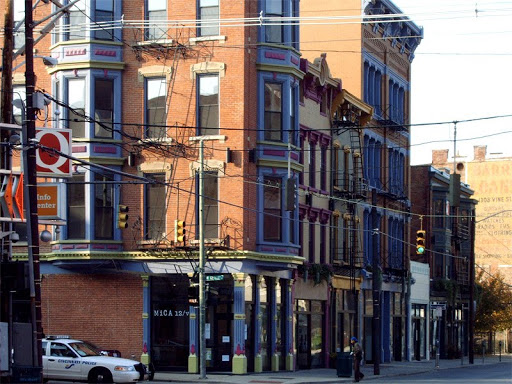
According to Walkscore.com, I live in a “Walker’s Paradise,” scoring 92 points out of a possible 100. Before I look further into why my address gets such a high score and why I think it might be a tad unrealistic, let me tell you why the “walkability” of my home is so important to me.

1. It familiarizes me with my neighborhood and familiarizes my neighbors with me.
Case in point: when I moved into Cincinnati and lived in the Northside neighborhood, my parents worried that it was unsafe. Although I’ll admit that I had a few uncomfortable situations there–mostly involving the vacant lot across the alley from my backporch–I realized something very important early on: Safety, in many ways, is a byproduct of living as if you belong where you are. For example, I took opportunities to familiarize myself with my neighborhood, get to know the streets, smile at the people next door (and say “hello!”), walk a lot, and begin to see my enviornment as a part of my life and not just something I drive through on my way between home and work. The same is definitely true living in Over-the-Rhine. Though the environment may be a bit more volitile, I’ve learned to take advantage of every opportunity to own my neighborhood. My hope is that as I walk up and down the street on my way to the Market or down to the library, I become a familiar face. Then, my neighbors will see me as less of a threat and I will become a part of the neighborhood.

2. The charm of a car-free life!
Right now, my husband and I each have a car that was brought into our marriage. Because both cars are completely paid-off, we have free off-street parking at home, my mother in-law is 20 minutes away, my parents are 300 miles away, and some dear friends live in the farther parts of the Cincinnati area, we have no immediate need/desire to get rid of our cars. But, we have often considered what our lives would look like as a one-car family, if we traded in both for one newer, more reliable family vehicle. This begs the question: could either of us survive the day without a car? I am a bit more excited about the prospect than my husband does, since I have come to love the days (like today) when my son and I go on an adventure around town–all on foot. Living in a place that is easily navigable on foot (or bicycle) means that I don’t have to mess with loading a baby in and out of a car just to pick up my few missing ingredients at the grocery store, check out the library’s most recent DVD purchases, or sneak into that corner store for a can of Diet Coke. No traffic. No parking tickets. No car insurance bills, registration fees, taxes, etc. It sounds great, doesn’t it?

3. I need the exercise.
I have never been a thin or particularly physically fit woman. That said, ten months after having a baby I seem fairly unscathed physically. I chalk that up to walking, and often carrying my child, around town. It’s that simple: I need exercise and if the only walking I do is to and from my car parked in the grocery store parking lot, I don’t get enough. It’s good for me to use my legs every once and a while, and it’s good for my son to get used to an active lifestyle while he’s young and can see it modeled in his parents.

4. What’s within walking distance says something about the values of the community.
With few exceptions, most folks don’t live near amenities such as locally-owned businesses, restaurants, cultural/arts institutions, colleges or universities, public parks, etc. unless they appreciate and intend to use them. Stated plainly: I choose to live within walking distance of Findlay Market because I want to spend time at Findlay Market and with other people who like to be at Findlay Market–these are my people. It seems obvious, but we often forget that we naturally gravitate to the things that are most important to us. And, where you live influences the way you spend money, which says a lot about what you value. Folks who live near Kenwood Mall should not be surprised if their neighbors spend more money at Nordstrom than they do downtown. And if they would rather spend time with people who spend time and money downtown, they should just move nearer to downtown. It seems pretty obvious to me.

Now, let me explain why the Walkscore of my Cincinnati home is a little misleading.

My walkability score is based on how close in proximity my address is to things like clothing stores, restaurants, grocery stores, and public transportation. Yes, I may be very near most of these things, but they aren’t all what they’re cracked up to be. For example, I don’t frequent “Bills’ Supermrkt” very much, since the majority of his inventory consists of malt liquor beverages and bagged potato chips. And, his close proximity helps bring up my walkability score even though his presence here actual diminishes my ability to walk down the street after dark. So, the score needs to be taken in context and with a grain of salt. For me, my interests, and my personal taste, my home would probably score more like 80 out of 100. That is still pretty amazing if you ask me.

Heck, if I were still in college, that could be a solid “B.”

My former address in Northside scores an 88 out of 100.
My former address in Elgin, Illinois scores an 89 out of 100.
I think those scores are probably more accurate.

What’s your score?
Do you think it’s accurate?

Urban Gardening–In a dumpster?

I came across an interesting post on Apartment Therapy’s Re-Nest blog.
Has anyone heard of Dumpster Gardening?

(Photo courtesy of the brilliant minds at Apartment Therapy.)

Click here for the link.

The idea, I suppose, is to transform abandoned trash dumpsters into planters for urban gardening. It seems like a good enough idea for someone like me with a couple empty parking spaces in my lot, but not a single blade of grass. But, are there really a multitude of abandoned dumpsters hanging around in your city?

Let me know if you spot one!