Kids: The More, The Merrier? (Part 2)

A few days ago, I rolled out some reasons why I support large families. You can read the complete post here but, in short, I offered these four reasons why having a big family might be better for parents:

1. Having multiple children spares you the delusion of your child as the standard.
2. More children means getting more use out of everything you bought for the first one.
3. Parenting a large family calls your priorities into question.
4. Parenting multiple children (especially when they’re young) is an endurance sport.


To follow up, I’d now like to offer three reasons why being in a bigger family might be better for your children:

1. Multiple siblings = built-in playmates.

This seems obvious, right? A kid with multiple siblings is never lacking for someone to play with–board games, baseball, a wrestling match, a pedicure, whatever. I know that play-dates with neighbors and friends are really important for socialization, but it’s nice to have a house full of friends. Will siblings always get along? Absolutely not! My two oldest are constantly hot and cold with each other. But, it’s awesome to watch their relationship develop and to see the sweet moments of love between them. This is particularly important to me as I consider what the future looks like for our family in the city. The “safety in numbers” rule will truly be tested with us as I teach my children to rely on each other and take care of each other in an environment that, though not particularly “unsafe,” requires a little extra oversight and preparation. But, even for families outside the city, a child with many siblings has no excuse for being bored or lonely.


2. Sharing with siblings teaches your child that the world does not revolve around them.

Right now, my two oldest children share a bedroom and my youngest will likely move into their room within a matter of months. And we are doing this by choice, not necessity. Three kids in one room. Crazy, right?

Not every only-child is spoiled. I know this. But, out of necessity, a child with multiple siblings must learn the art of sharing. With the exception of families with unlimited space and financial resources, there is no other option for multiple siblings. Why does it matter if a five year-old has to share a bedroom, his toys, or his mother’s attention? Among other reasons, it teaches him that the world does not revolve around him; he is not the only one with legitimate needs or desires. And it instils patience and generosity in the way he deals with those needs and desires in the people around him. It also teaches him that he is not an island, that his life affects others’, and that he has a responsibility to care for others’ things the way he cares for his own. Sharing a home with multiple siblings teaches a child the importance of shared responsibility and respecting shared space. It will (hopefully) make him a better friend, a better college roommate, and a better husband.


3. Having multiple siblings allows your children a built-in support system at the end of your life.

“End of life planning.” A major kill-joy, right? No one wants to think about their impending death or the impact it will have on their family. But, even if we assume that we will live to see our 90th birthday, we have to consider now the responsibilities that will fall on our children then and how to insure that they will not have to bear the weight alone. Caring for elderly, ailing relatives is a big job. And it might be even more emotionally demanding than physically. There is a benefit to multiple siblings sharing the responsibility, especially when there are two parents ailing at the same time. This obviously has its own mess of difficulties, because not all families of siblings will manage the shared responsibilities well. But, if parents are proactive and make decisions early about how their children can help manage it all–their medical care, finances, living situations, and (eventually) their deaths–then there is less decision-making for their children to do and they simply have to divy-up the job. Their multiple siblings will be a built-in support system when they face this difficult situation, one we all face eventually. They will not be left alone. They will still be surrounded by family.


Even though I am a huge supporter of large families–for both the reasons I’ve outlined and more–I’m not willing to force the issue of family size into a black-white category.

So, I’m curious–How many siblings do you have?
How many children do you have?
If you had a choice, how many would you have??

Have you found any of these reasons to be true in our life and family?


Kids: The More, The Merrier? (Part 1)

It’s happened to all of us with young children.
We’re in the store or the library or on the sidewalk waiting for the walk light with our children when a well-meaning stranger takes a look at our morning hair, mismatched clothes, and pint-sized companions and says: You’ve sure got your hands full!

Duh.
Thanks for the reminder.

I have three children, 5 years and younger. And in today’s America, that is considered a “large family.” A few years ago, I read a news story about a pretty significant reduction in birth rates over the past 50 years, but I didn’t need anyone to tell me that families are shrinking in size. One child is nice; two children is good; maybe have three if you’re feeling brave.

I’ve heard a lot of reasons for limiting family size–everything from ecological (“The world is ending! We need to stop procreating!”) to economic (“Kids are too expensive.”) and personal (“I hated my sister; I want my daughter to enjoy being an only child.”) reasons. But, even if the trends for post-Boomers were leaning toward having fewer children, I read an article recently that suggested birth rates may be increasing among (Canadian) Gen Y and Millennial moms. And, not only that, but another article suggested that more young women are choosing to be stay-at-home moms (Gasp!).

I, for one, welcome a rise in birth rates, not only because it means more playmates for my kids but because I believe that big families are good–good for kids and good for parents.

So, the more, the merrier.

I understand that many people would welcome a larger family if they felt it was possible. And there are plenty of my peers who stop at only one or two children because of circumstances outside their control (like infertility and difficult adoption costs and processes, for example). I know plenty of parents of single children who are awesome, loving parents; and I know plenty of only-children who turn out to be fantastic adults (I married one). So, this is not an indictment against those people. This is a statement of support for big families. I write this mainly for those who are still undecided about what numbers is the “perfect number” or for those who have already settled on a small family. And, especially, for those who want a big family but need some encouragement to take the leap from 1-2 children to 3+.


Why having a bigger family might be better for you:

1. Having multiple children spares you the delusion of your child as the standard.

When you have your first child, it’s easy to assume that your experience can be translated to every other parent/child in the world. It worked for you, so it will work for them, right? Everything from childbirth to sleep-training, breastfeeding and learning to ride a bicycle–people with only one child tend to think of their child as the plumb line for everyone else. But, what happens when you have more children? You realize that every child is different. You can parent four children in the very same way and come up with four very different “results.” One will want to be held; one will want space. One will sleep well from birth; one will fight sleep until they turn six. One will learn to potty-train at 2 years-old; one will struggle into preschool. Parents with more children seem to be more adaptable to different children (those both like and unlike their own) and more gracious in the way they deal with other parents because, when it comes to difficult parenting situations, they have been there and know that no one gets it right the first time every time.


2. More children means getting more use out of everything you bought for the first one.

When they are young, I buy most of my kids’ clothes used. Sure, it saves me money. But it also saves resources. Walk into any kids’ used clothing store and you’ll be amazed at how much stuff people buy, use once or twice, and then get rid of. Having a big family is often viewed through the lens of sustainability, in which increasing the population increases waste. But large families aren’t necessarily wasteful. Most large families that I know take good care of their kids’ stuff (because there really is a lot of “stuff” that comes with kids) and keep it through multiple children, often handing if off to another family when they’re done. In this area, the difference between having 1-2 children or having 3+ is very minimal. When my third child was born, there was basically nothing I needed for her. Everything–clothing, furniture, toys, and diapers–could be reused from my older children.


3. Parenting a large family calls your priorities into question.

Adding more children might not be the earth-shattering financial disaster that some small-family proponents would lead you to believe, but having a large family does require particular sacrifices that small families do not have to make. Need an example? Try finding an affordable/fun/logistically-feasible vacation for a family of 5+. (Have you ever priced plane tickets?) Another example: Forget your anti-minivan ideology–you’re moving into 12-passanger van territory here. How about this: It’s pretty easy to find a babysitter for one or two darling children. Who’s going to come watch 4-5 of them while you go on a date or go somewhere overnight or go to get your haircut?

A large family necessitates reorganizing priorities. And I mean this in a good way. Committing to parenting multiple children means committing to a near-lifetime of sacrificing the convenience of a child-free life for the full-time, nonstop world of underage companions. Regardless of your family size, parenting requires a lot of work and sacrifice. It involves a lot of saying “no” to yourself–time alone, career aspirations, creative projects, shopping trips, etc.–for the sake of caring for those children. For many young adults, this is reason to postpone, or avoid completely, the task of parenthood. But, to be honest, most of us could afford a little more generosity with our time, money, and energy. I’ve heard it said this way: You’re going to spend it somewhere. Why not “pay it forward” to a brood of children, rather than spending it all on yourselves?


4. Parenting multiple children is an endurance sport.

I’m not a runner and I don’t have an hour a day to swim laps or walk on a treadmill, but catch me at 8pm on any given day and I feel like I’ve been running for miles. Keeping up with kids (and taking care of a home and making food and keeping myself breathing and adequately dressed) is hard work. And, similar to running a long-distance race (or so I’d assume), it requires just as much mental and emotional training as it does physical. It is good for you. It is challenging and difficult and, if you let it, it makes you better. There are some days when I collapse after bedtime and think, “I can’t believe I kept them alive today.” And then there are days when I, literally, feel like I just climbed Mt Everest and I feel awesome. Like a superhero. Like I can conquer anything.

Parents of big families have nothing to prove. They don’t need fancy cars or spectacular homes or impressive resumes to show that they have made something of their lives. They are–literally–growing a generation. Assuming that their children don’t end up as spectacular disasters, which is possible, parents get to sleep at night knowing that the fruit of their labor is not accumulating dust in the garage or “appreciating” in a bank, but that it is slowly growing into the men and women who will one day conquer their own mountains and run their own races. Parenting is a long-term investment. It is a marathon–not a sprint. When it’s over, you will be dog tired and wonder how you had the strength to do it. And you will feel awesome about the way you spent your days, even if all you have to show for it is a full heart and a full home.


Need more convincing?

Look me up in a few days for Part 2: Why being in a bigger family might be better for your children.


Why Diversity Matters To A Conservative Mom Like Me

Diversity matters to me.

It seems counter-intuitive, doesn’t it?

When imagining the lifestyle of a “conservative Christian housewife,” the mind isn’t usually drawn to pictures of diversity. Instead, we usually picture privacy fences, kids who “don’t talk to strangers,” and family conversations about Us vs. Them. But one of my deepest commitments in the way I parent and educate my children is to their early and intentional exposure to diversity.

This is one of the things I love most about our life in the city.

In the most basic terms, the defining characteristics of an urban environment are density and diversity. Conversely, sub-urban areas are characterized by sprawl and homogeneity. One of the most common misconceptions about sub-urban places is that they are better for families. And, more often than not, what people mean by “better for families” is that the social, economic, and ethnic homogeneity makes it easier for parents to navigate.

When most of your neighbors look like you, make about the same amount of money as you, and vote like you, their culture is familiar. There are fewer conversations with children about why the neighbor “looks like that” or “eats that kind of food.” And there are fewer difficult conversations about why that other neighbor does that thing that you absolutely do not do.

But, does that really make it “better?”
Better by what definition?

Do parents consider the long-term effects and implications of a childhood with little to no experience with anyone different than themselves?

Now, some sub-urban areas are more dense and diverse than others, especially as many suburbs are being retro-fitted with more characteristically “urban” developments. And every childhood is formed under the direction of parents, so every suburban child’s experience will be different. But, I suggest that parents–especially those who identify as Conservative–should consider the benefit of building a family life in which their children are regularly and positively exposed to diversity, regardless of where they live.

Let me offer two reasons why diversity matters to me.

First, early and intentional exposure to diversity could help release my children from bias and bigotry as they grow older. This is obviously not a guarantee. I believe that bias is a natural (fallen) reaction to cultural differences. But parents can direct a child toward experiences that help them navigate diversity with wisdom, not fear or misunderstanding.

I was a suburban kid. And most of the people I knew as a child came from families very much like mine. But, I went to a public high school that was about a million times more diverse than the neighborhood I was from. So, even if my early childhood was not characterized by diversity, my adolescence was a bit more. I didn’t understand the impact this diversity had on me until many years later when my husband took me to a high school football game in his hometown. It took me a few moments to realize why the crowd was so strange to me.

“Wait,” I asked him, “where are all the black people?”

My husband attended a high school where the student body was nearly 100% white. But I, though I lived in a predominately white suburban neighborhood, attended a high school that was remarkably diverse, both ethnically and economically. So, my early experiences with my minority peers–particularly African American and Middle Eastern–were as diverse as these cultures themselves are.

There was nothing inherently wrong with the homogeneity of my husband’s almamater. Public schools simply reflect the lines drawn by school districts. But I do believe there was an inherent strength to the diversity of my school.

It’s impossible to be completely bias-free, but I credit my diverse high school with helping me have a bit more realistic view of people who are different from me. You see, black people and Muslims and gay kids and poor kids and unwed mothers were not “those people” who lived in the other part of town or went to the other school. They were my classmates. They were football heroes, the student council President, and my co-star in the school play. They were people. Actual people. People with names and talents and fears and dreams–just like me.

The diversity that my children experience in the city on a day-to-day basis can be difficult at times. There are still questions that I haven’t figured out how to answer about the differences between our family and some of our neighbors. The questions we do answer, we sometimes only answer in part while our children are young and are satisfied with simply, honest answers. We are still different, after all. And our children get that, even if they don’t understand to what extent.

I can’t guarantee that my children won’t carry bias into their adulthood, but what I’ve tried to provide is a more broad experience in their childhood so that “those people”–the people who are different from us in any given way–are not strangers or numbers or ideas. They are people. Actual people. They own businesses and restaurants; they have ailing parents and they have rowdy children; some have good jobs and some ask for change; some are lazy and some work really, really hard.

They are our neighbors and friends.
They have names. And talents. And fears. And dreams.
Just like us.

I believe that our experiences with diversity as a child influence our interaction with diversity as an adult. When people who are different are kept at an arm’s length, they have no identity other than the thing that makes them different. They have no humanity. No dignity. And their complete other-ness makes them easily misunderstood. Teaching my children to acknowledge them as more than “different from us” teaches them to acknowledge their God-given dignity. And that is the foundation I would like to build for my children as they approach adulthood so that they don’t need to spend their young adult lives undo-ing the bias they were given as children. Instead, I want them to spend their young adult lives determining how they will engage with the world as adults.

And this relates to the second reason diversity matters to me:

I believe that the Christian faith lends itself to an active relationship with a diverse society, a relationship that is mutually efficacious.

Now, I would be foolish to claim that I am even near to perfecting this subtle dance between remaining apart from the world while establishing relationships and engaging those who are different from me. (Especially when my young children are involved.) But I know that this dance can’t be learned without first jumping in.

In the same way that Christians have to learn to human-ize people who are different from us, I want to help make Christians more human to those for whom we are “those people.” You see, when Christians disengage and remove ourselves from diverse populations, we become nothing more than a foreign idea. We appear irrelevant to the world. And we have no identity apart from our other-ness. But when we engage, when we make ourselves present in the lives of people are are different, they can begin to understand us as real, actual people. And that will, perhaps, give them a better understanding of what, exactly, this peculiar people who call themselves “Christians” are actually all about. And I believe that what Christians are actually (supposed to be) all about is good for the whole world.

We may be kind of weird to some of our neighbors. And they may not understand why we vote the way we vote or why we homeschool or why on earth we head to church every Sunday while they head down the street for waffles. But they will, hopefully, know us in other ways. They will know the names of our children and they will sit at our table or chat on our front stoop and they will (hopefully, someday, when I figure this all out) know that we love them.

I want my neighbors to know that we see them as more than “those people” who live in a different part of town.
Because they don’t live in a different part of town.
They live here.
With us.
And that actually makes a difference.


Are You Prepared?

Truth be told: I have survivalist tendencies.

I don’t speak a lot about preparedness because I don’t want people to see me as a weirdo Doosmday Prepper, building a bunker in my basement and storing ammunition under my bed. (I am doing neither of those things, btw.) I am a planner by nature. So, emergency preparedness is a manifestation of that need to plan ahead and be prepared for any situation, especially now that I am a wife and mother and have more than myself to take care of.

I think my interest in survival scenarios started young. While some of my female peers were reading The Babysitter’s Club, I was reading books like Hatchet. When I was a bit older, my taste gravitated more toward dystopian apocalyptic literature and movies. Then, when I entered college, more toward outdoor survivalist and adventure stories. The “What would I do in this scenario?” question has always been exciting for me. When I had my first child, I developed a lot of post-partum anxiety. So, my natural need to feel prepared has been both a blessing and a curse.

Living in a city, we take for granted the fact that we can get anywhere we need to get, to get anything we need, at any time. But we should know better than that. I have no desire to breed fear or anxiety in other people (because, Lord knows, I have enough for myself), but do you ever stop to ask yourself, “Are you prepared?”

Enter, the Polar Vortex.

Now, I am a Chicagoan by birth, so cold weather is not new to me. And, in general, I handle the worst of Cincinnati’s weather pretty well. But I will admit that there have been a few really cold days this winter and it appears that some more is headed our way. When extreme weather hits, it has ripple effects that run through all aspects of our lives. In the past two months, around the country, we’ve read story after story of the effects of extreme cold, ice, and snow: cars stalled, traffic stopped for hours, huge highway pileups, water pipes bursting or freezing, electricity down, busses stranded, etc.

And how about the recent chemical leak in West Virginia? Did you hear about it? We were lucky to be a large municipality, far from the leak. But, still, the City of Cincinnati had to close off intake valves from the Ohio River and use stored, treated water for a day while the hazardous material floated past the city. What if you were one of the 300,000 people further up river who had no drinking water because of the crisis?

Now, consider hurricanes, floods, extreme heat, earthquakes, tornados. These are just the natural disasters.

What if you had no access to the public water system for 24 hours? 48 hours? 72 hours?
What if your heat went out? Or your electricity?
What if your city closed the roads for three days and the grocery stores couldn’t receive deliveries?
What if you couldn’t leave your home for a week?
Or what if you absolutely had to leave your home for a week?
What if you only had an hour to leave?

These are questions we don’t like to ask because they make us feel powerless and vulnerable. But we have to ask them because we are powerless and vulnerable. And, if we don’t ask them, then we stay powerless and vulnerable.

Part of dealing with my anxiety has been reconciling my powerlessness and relinquishing control over things I cannot control. The other part? Being reasonably prepared.

There are four phases of preparedness.

Immediate.
This is preparation for a sudden, local emergency like a power outage or public water loss. It also includes car emergencies like being stalled on the side of the road or being stranded away from home. A good estimate of time for supplies is 72-hours. Preparations include simple emergency kits for on-hand at work or school, and in vehicles. Basically, if you were stranded in your house or in your car or in your office for 1-3 days, what would you need to survive?

Extended.
This is preparation for a few weeks of limited access to resources in times of civil unrest or after a disaster situation like a tornado. Preparations are usually as simple as keeping bulk supplies of what would normally be found in a functioning household, including water for drinking, cooking, and bathing. This would also include short-term evacuations.

Long-term.
This is where we get into the real “prepper” scenarios that make for tv-worthy entertainment. This goes beyond a few weeks’ worth of supplies and veers into months’ to years’ worth of stored food and sundry items, alternate sources of water and heat, and means of protection (i.e. firearms and ammo). This phase also considers long-term evacuation situations. Think: New Orleans, post-Katrina.

Perpetual.
People who enter this phase of disaster preparedness are generally preparing for a complete collapse of society, lone-wolf survival, and living off-the-grid. Have you seen the show Revolution? Imagine yourself in that America.

As much as survivalism and emergency preparedness fascinate me, I have not ventured much past those first two phases of preparedness that I outlined above. I’m just not convinced that there is an urgent need. So, I’m definitely not suggesting my friends cash in their IRA, buy a dozen acres, and bury a bomb shelter for the apocalypse. But, there are simple, affordable ways to prepare for potential emergency situations and it surprises me how few of my friends (especially those with children) haven’t even considered doing it.

The American Red Cross has a pretty good list of resources and tools for emergency preparation. This is probably a good place to start if the concept is new to you or seems overwhelming.

Like I said, I don’t talk too much about emergency preparedness because the “Prepping” world is a bit of a freak show that I’d rather not associate myself with. But, I think I have a responsibility to protect and provide for myself and my family in an emergency situation. It’s not quite as simple as keeping a few extra batteries and boxes of cereal in the house, but it’s also not as difficult as you may think.

Consider it.

(I’m happy to post more online resources if anyone is interested.)

What’s In Store for 2014

I’m not one for New Years Resolutions. I never keep them, so I stopped making them. But, I do think that a new year is a great time to make plans for a new season of life.

With that in mind, there are a few things I’m prioritizing for 2014.

Working on de-cluttering, purging, cleaning, and repairing/replacing around our home. Living in an old (over 100 years old!) home means constantly keeping an eye on repairs and updates. Our house is, thankfully, in good condition structurally-speaking. But it needs many cosmetic and comfort updates. This may be the year we get new couches and central air conditioning! Whoo-hoo! And there are about seven million things I could get rid of right now if I got serious about it.

Hosting more events. Long before we were married, my husband and I realized we were a great event-planning team. In fact, one of the reasons we chose our first apartment and our first home was that they both offered space for hosting events. We’ve been using our house as an independent arts venue since we moved in and I’m hoping to continue doing so. On the top of my list of people to host? These guys.

Setting things in place for a more structured homeschool schedule in fall of 2014. This means: initiating a more structured family life with loosely scheduled waking, cleaning, eating, outdoor, and reading times. As a mostly un-structured person, this will be a challenge for me, but I’m going to make it happen for the whole family’s benefit. (I’m really excited to add tea time–yes, I said “tea time”–to our daily routine.) I’ll also finish compiling my library for Grades 0-1 (see: Ambleside Online) and starting Izzy on his nature journal. For a kid who loves to read and draw, this is going to be a fun year.

Writing more music. Did you know I’m a songwriter? Yeah, me neither. Who would have known that child-rearing would suck all of my creative energy? I’ve taken up blogging since having children, but I haven’t written a song in years. I’m hoping that 2014 is the year I re-learn the art of songwriting as an adult/wife/mother and see where it takes me. If I can’t write anything new, I hope to at least master some songs that are new to me, some of my favorite folk songs, hymns, and lullabies.

Being a better wife and friend. Relationships have never been “easy” for me. As a very self-aware introvert, any level of social awkwardness or emotional vulnerability gets me running in the opposite direction. My marriage, as always, must remain my top priority on the relationship front because, as my husband could tell you, my relational dysfunction affects him the most. Also, during the past few years, I’ve tried to hone in on my “girl friend” issues (i.e. why it’s so hard for me to have female friends) and I am going to work really hard on developing and maintaining relationships with women I love and trust. I have made many wonderful friends here in Cincinnati and I need to work on making those relationships prosper.

Learning how to dress myself. What is second-nature to one person is a foreign language to another. And, in all seriousness, fashion has become a foreign language to me and I need to learn how to speak it. This is the year that I learn what is appropriate for an articulate, semi-creative, 31 year-old, urban, mother of three to wear. I got some killer shoes for Christmas, so at least that’s a start…

Getting more sleep. (Maybe.)

Wish me luck!

(What about you? Have you made any resolutions??)

Here at Home

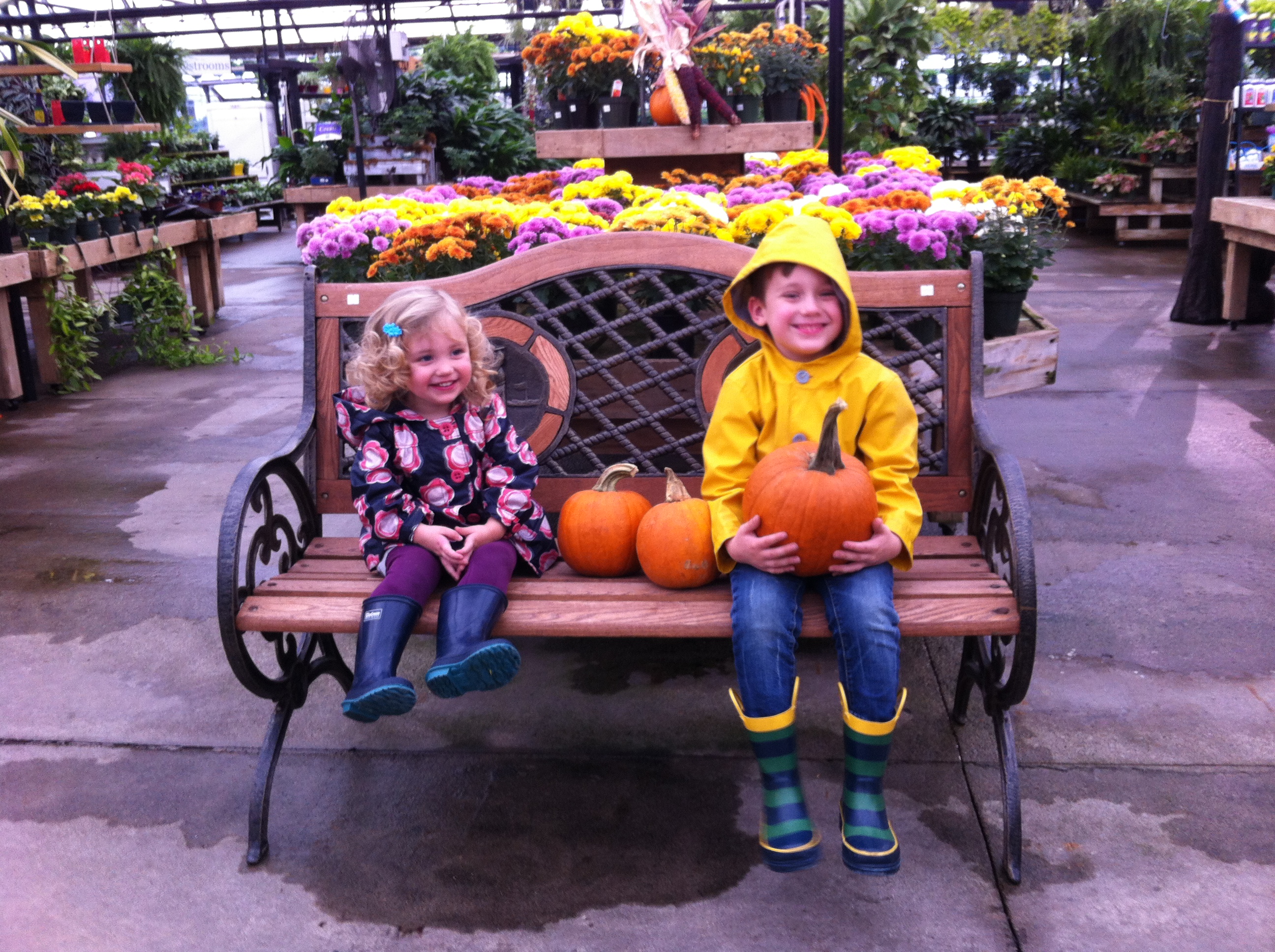
Fall came quickly this year and we’re taking it all in.

IMG_6658

I have a few blog posts planned for the next few months, but I’m honestly enjoying the distraction of family, friends, and seasonal celebrations. It’s moving too fast (Next week is already Thanksgiving!) and these kids are growing like weeds.

Stay tuned for:

– Locally-sourced Christmas gift ideas.

– My most recent thoughts on the Cincinnati streetcar debate.

– Meditations on Advent and New Years.

– What I’ve been learning about the blessing of “daily bread.”

For now, enjoy the season. It will be winter before we know it and you’ll miss all this color!