Getting Around: Do I Really NEED a Stroller?

Before our son was born, my husband and I avoided much of the pre-baby purchasing craze. We purchased only a small percentage of those “must-have” toys, gadgets, and pieces of furniture and picked up the rest of what we actually needed when we discovered that we did, indeed, need it. Because we were prudent in our purchasing, we saved a lot of money and have less (comparatively) to store in the crawlspace until we decide it’s time for baby #2.

But, all prudence aside, there was one item that I obsessed about for months: a stroller.

Up until the point I actually purchased our stroller (a month or so after our son’s birth), I obsessed about which stroller to buy. I no longer noticed the cheery grins on the faces of babies in passing. Instead, I noticed only their stroller–the brand, the color, the style. And, I took mental notes of each stroller I’d actually seen in person, weighing the size and shape. And, of course, the price.

Some friends told me that a stroller was not a big deal: “Just get a cheap one; I barely use mine,” they said. For some, that might be true. If you only intend to use a stroller at the mall, or for the occasional walk to the park, it really doesn’t matter too much which stroller you get. But, for a parent who lives in a city and plans on walking a few miles a day, a stroller is a big deal. And because I didn’t have a thousand dollar stroller budget like some parents in Park Slope or LA, I couldn’t just order the latest hip-mamma stroller spotted in a magazine.

Like any niche market, the world of strollers is vast and becomes quickly overwhelming.

Things to consider:

Price– Is your budget $200 or $2000?

Age Range– Do you need a stroller that adapts to hold an infant carseat? Do you want a cot or full recline for a newborn? Do you want to be able to use it when your child is three years old? Do you need a stroller that can become a double stroller for the next child?

Size and Weight– Will it fit in your trunk? Can you lift it with your child in it if you need to navigate stairs? Can it maneuver on the sidewalk/between store aisles?

Other considerations– Is it practical for where you will use it? Where is it made? Are the tires better for flat surfaces or uneven surfaces? Does it fold up easily/quickly/with one hand? How well is it constructed? With what materials is it made? How large is the storage compartment? It the seat wide enough for your child? Does the seat seem comfortable for long walks? Does it have a warranty? Does it come with accessories or will you need to purchase other pieces separately? Can you use it with the infant carseat you’ve already purchased or registered for? Is the color scheme gender neutral to use with future children?

You may be thinking: Seriously? Does it really matter that much what stroller I purchase?

Take this into consideration: For the past 18 months, I’ve taken an average of 3 walks a week around downtown to run errands, grocery shop, visit the bank, etc. And if each of these walks averages about 3 miles, that’s roughly 700 miles I’ve logged on my stroller so far. And, I intend to use it up until we have another baby, which adds many more miles to its lifespan.

Basically, my stroller is a tool that I will have used almost every day for 2-3 years. So, I’m thankful that I took my time picking out a stroller that was exactly what I needed, for what I could afford to spend.

On a personal note:

I ended up purchasing the Baby Jogger City Mini stroller and the infant car seat adapter, which allows the stroller to hold many of the most popular infant car seats. (I found a Maxi Cosi car seat at a discounted price online because it was in a discontinued color!)

The stroller is everything I’d hoped for. It’s lightweight, sturdy, sleek, super easy to manuveur, and my whole “travel system” (stroller, adapter, car seat) only cost a total of $425. This might seem like a lot, but when you compare it to a moderately priced “travel system stroller” you can purchase at Babies R Us for $325, you’re only paying $100 more for something that is about a million pounds lighter and a million times easier to use and travel with. (And a lot more attractive, if you ask me.) I’d say I made a heck of a purchase, especially considering the stroller I was really lusting after would have set me back an easy $900 for the entire “travel system.”

For parents who don’t have $1000+ to spend on a fancy stroller, I highly recommend the Baby Jogger series. Baby Jogger makes everything from hip, urban fashion strollers like their City Select (starting at about $500), to bonafide jogging strollers like their Performance Jogger which runs about $450. Mine is their mid-priced urban-use stroller. They have recently released a Bassinet/Pram accessory and a Glider Board for an older sibling to ride along, giving their single strollers an extended life. Many of their strollers can be purchased as a double stroller, and their City Select is a multi-use stroller for infants or toddlers and can be adapted to be a double stroller.

One large caveat is that big-box baby stores like Babies R Us don’t sell many high-quality strollers, at least not in-store. So, in a Midwestern city like Cincinnati, it’s hard to find floor models to test drive. My advice: visit every high-end baby store you can find within a reasonable distance and look at everything. Seeing a $1200 stroller in-person will tell you whether or not it’s really worth your hard earned money. Likewise, test-driving a cheaper stroller that the manufacturer is trying to pass off as high-end may convince you that it’s worth paying the extra $100-200 for the better stroller. (Hint: 3-wheels does not equal high quality.)

When you can’t find floor models, you can make up the difference by doing a lot of online research. Read reviews. Read parenting blogs. And don’t be embarrassed to stop a parent on the street and ask about their stroller. Chances are, if you see a parent using a high-end stroller, they would be happy to tell you about it and give a quick review.

In short, if you are not going to use your stroller a lot, then maybe a $100 stroller is a good idea.

But, if you live in the city and would rather enjoy your walks downtown, maybe reconsidering your priorities is a good idea. For us, it was a choice between purchasing “baby furniture” or a nice, attractive, high-functioning stroller.

I am very glad I chose the stroller.
Kids Not Welcome

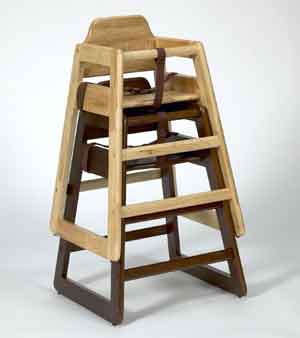
Every time a new restaurant/diner opens downtown, and a friend tells me of their recent visit there, I ask a simple question: Did you see any kids or highchairs?


Most people, obviously, don’t look for a highchair when they walk into a new place. But, from a parent’s perspective, the absence of this simple object says one thing to me: Your kids are not welcome here.

I can understand a restaurant owner’s fear of becoming a *gasp* “Family Restaurant,” and I can understand that a toddler is not their primary clientele. But, I also know that there a very large number of young adults with young children who would love to be able to support these local businesses, but the businesses seem to not want their support.

Yes, I can still sneak in with my son and let him sit on my lap while we both try to eat. And, yes, a booster seat is a step in the right direction. But, a young toddler is much more likely to sit still if seated in a high chair. My son is very well behaved (and we know when our son is not behaving and it’s time to leave). Heck, these business owners might actually like having us around!

So,

Dear Business Owners:

I support local business and I’d love to support yours. But, until you are willing to accommodate my small and well-behaved family, you’ll be relegated to my “date night” restaurant list. This list is large and not often consulted for dinner plans. Maybe we’ll see you (and you’ll see our money) in a few years?

Sincerely,
Your neighbor.

(And don’t even get me started on coffee shops and gas station bathrooms without diaper changing stations… ugh!)

Sharing Space in Urban Homes

It’s a common deterrent for those looking at urban homes, condos, and apartments: “We just can’t find a place big enough.”

For those who live alone, are married and child-free, or cohabitate without children, this might not be an issue; one or two people can easily squeeze themselves into a small living space and get comfortable there for a long, long time. But, what about those of us with children? Not just that, what about those of us who want multiple children?

How can a large family (I’m talking about a family with at least two children) find a place that’s affordable, while allowing each family member enough room to stretch their legs every once and a while?

Some options to consider:

1. Share your bedroom with an infant/toddler.

My husband and I lived in a loft apartment when our son was born and, therefore, ended up sleeping in the same room as our son for the first 18 months of his life. We started with a co-sleeper attached to the bed, then moved it to the wall next to the bed (4ft away), then to the other side of the room (about 20ft away). This arrangement is not nearly as inconvenient as one might think and comes in really handy for a mother who plans on nursing her children past their first year. In such circumstances, this arrangement is actually more convenient. In our new home, our son sleeps just on the other side of our bedroom door (but usually ends up in our bed at about 6am each morning anyway). Frankly, we have grown accustomed to him being nearby and we like it that way for now.

It should not be assumed that, once a couple discovers there is a baby on the way, they must shop around for a two-bedroom home. Sharing a room with your child may not work for everyone, but it’s at least worth a shot. You can all be perfectly comfortable sharing a bedroom for a very long time, before you ever need to consider “upscaling.” And, when the time comes to shop around…

2. Reconsider “bedroom.”

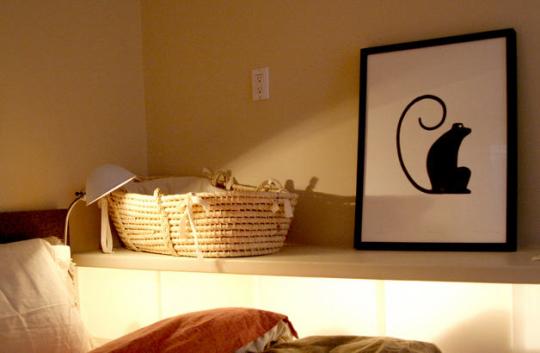
Why does a toddler (or a preschooler, for that matter) need a large bedroom? I can understand a parent’s desire to create a space unique to their child. (I feel that desire, too.) But, is a separate room really necessary? Take a quick search through home design blogs and you’ll find examples of excellent kids’ space built into closets, attics, breakfast nooks, lofts, and other odd places. A child can be afforded plenty of privacy, seclusion, and creativity in any sort of space, regardless of size. (This includes even tiny outdoor spaces, which are often overlooked when it comes to providing space for kids.) When did our idea of “bedroom” expand to include a private library, playroom, bathroom, and walk-in closet? With a little creativity, any extra bit of space can be transformed into a bedroom for a small child! And, when all else fails…

3. Think “Bunkhouse.”

I grew up in a house where both me and my two brothers each had our own bedroom, so I understand the desire for individuality, privacy, and space. And I know that there are many benefits to living in a large home–especially when considering entertaining guests. But, just because there are benefits to each family member having individual private space, we shouldn’t feel like we are neglecting our kids by making them share their bedrooms. In fact, it might be in their better interest to learn to share space now, before they find themselves in their freshman year at college, fighting with their new roommate over whose job it is to wash the window.

I’ve seen some amazing ideas online for shared bedrooms for kids–everything from a preschooler sharing with a newborn, to preteen siblings (a brother and sister, nonetheless) learning to give each other space in a room where space is limited, to four sisters sharing a room well into their teens. From my own experience, thinking of the friends I’ve known throughout my life who have siblings, it seems that most shared their room at some point in time. I might venture to say that, with some exceptions, most would not have had it any other way. Sharing a bedroom teaches children cooperation, consideration, and aids in bonding. Think: summer camp every day.

Sure, there are some sisters who end up as enemies from childhood spats in their shared room; and there are certainly stories I would have rather not heard about shared boys’ rooms. But, we all need to learn to share space eventually and we shouldn’t feel guilty if we start our kids young. Heck, they might end up as best friends because of it!

I guess my point is pretty simple:

If we think that a growing families necessitates a growing home (which often insinuates moving out of the city), we are missing out on the ways we can adapt the space we currently have to meet our growing needs.

Why can’t a family of four be comfortable in a two-bedroom home?
Why can’t a family of six live in a three-bedroom home?

I know that there are obvious caveats to this: to keep the average person sane, there must be at least some private space or some way to get away from the others–a quiet reading nook, a cozy bathroom, a backyard patio. So, that’s where creativity comes in!

What’s the coolest space adaption you’ve seen a family make?

Photo credits:
1. Apartment Therapy
2. oh happy day
3. Cookie Mag

Summer is Over?

Wait!

Today was the first day of class at Cincinnati Public Schools and I’m amazed. Has Summer really passed by so quickly? Did school start this early for me when I was a child?

I’ve noticed recently how slowly I seem to be moving compared to my surroundings.
Maybe it’s my lack of media consumption that keeps me out of the loop;
Maybe it’s the constant attention I give to my toddler;
Maybe it’s my husband’s busy building schedule;
Maybe it’s our move from busy Vine St. to this quiet, tree-lined street five blocks away.

In addition to the start of the school year, which always signifies the official end of Summer to me, downtown Cincinnati–and Over-the-Rhine, specifically–seems to be moving very fast. New restaurants; new shops; new neighbors. It’s enough to make a girl like myself yell, “Stop! I just can’t keep up!” I swear, even though I leave the house every day and walk these streets, I cannot seem to move quickly enough to participate in all the excitement!

More often than not, in conversations with other young parents who live outside the city, I hear a lot of “Oh… I wish I could move into the city, but….” And then they elaborate on one of many (sometimes legitimate) reasons why moving into the city is unrealistic for their family.

To them, I say that there could not be a better time for young families to move into the City of Cincinnati.

Heck, I will go so far as to say that there has never been a better time to live downtown.

(And this is not the idealism of a brand new resident speaking. I’ve lived in OTR the better part of three years and worked here the two years before that. Even though I may not be a long-term resident yet, I’m definitely not new to the scene.)

It’s an exciting time to be in Cincinnati, no?

I only wish I had more time to spend with neighbors, make new friends, eat new foods, buy new goods, and take it all in. Maybe as the weather cools, time will slow down a bit and I will get a chance to really inhabit our great city.

Happy end of Summer, folks!
Maybe I’ll catch up with you in the Fall?

Looking for Advice!

What would YOU do?

My husband and I are now three weeks into our new home and we love it, but still have a monstrous amount of work to do before it feels like it’s “ours.” One of the questions on the table–along with a complete remodel of the kitchen, updating of three bathrooms, and all new flooring–is what to do with the backyard.

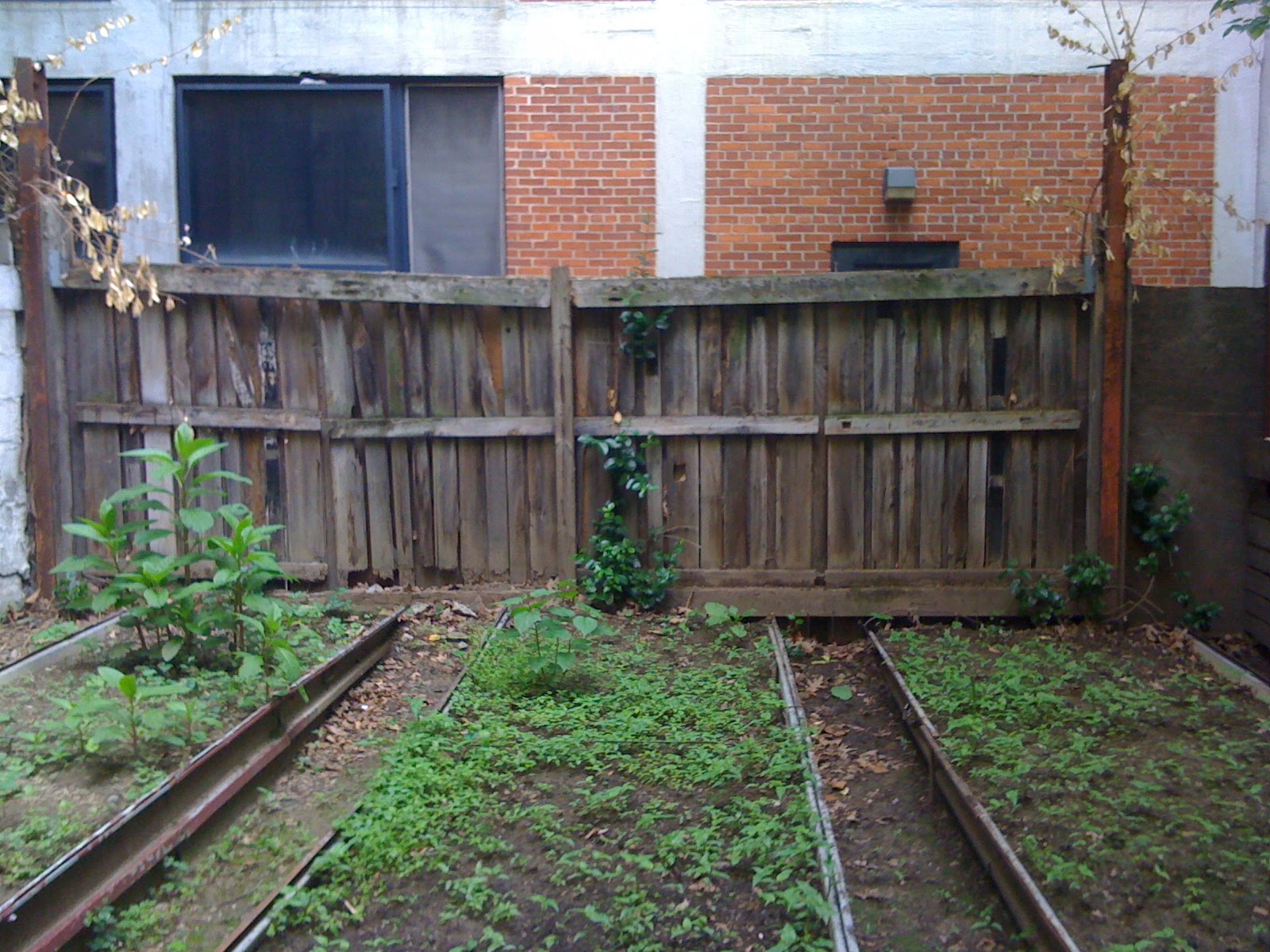
The current condition:

It is fenced-in and measures about 20′ wide by 27′ long. There is a gate leading to the adjacent yard, which is confusing but not particularly troublesome. It is completely shaded most of the day; the eastern 1/3 of it gets sunlight at the day’s peak. There are three raised planting beds lining the back fence, parallel to the house and one ground-level bed next to the house. I have no idea what was/is planted in the beds. Grass has not been able to survive in the yard for the past three decades, the yard is not level, and the soil is fairly impermeable.

The building-side planting bed lies directly below what was once an exit from the first floor (bottom left of the photo). Though a walk-out is still possible, that room is now a large utility room and the door has been blocked by a screened-in and locked gate. It is about four feet above ground level.

The kitchen is now on the second floor and has a screened in landing that was designed to lead to a nice walk-out, as well.

The entrance to the basement is at ground level on the other side of the building, with our sidewalk alley to its side.

Although we have not experienced any serious parking problems yet, my husband would like to tear down the back fence and pave a parking space. This would be especially helpful for my husband’s need to access the basement for work and for visiting guests so they won’t have to mess with on-street parking. We also believe this might increase the resale value of the home much more than landscaping would. BUT, we would sacrifice the security and privacy of our small yard–which is priceless, if you ask me. Our best idea for parking involves paving a diagonal space that leaves as much of the yard in-tact as possible. One problem: the alley in the back of the property is narrow and cannot accommodate a large vehicle. Although we don’t intend to purchase a Hummer anytime soon, we will be having more children eventually and will probably end up with a vehicle larger than a Mini Cooper. So, is the parking space even worth the trouble?

Some other ideas:

-Since the ground level is fairly useless at this point, we’ve considered creating a parking space covered by a greenroof/deck that extends all the way to the second floor. Basically, raising the entire functional greenspace 10ft or so above ground.

-We’ve considered turning the utility room into a small summer kitchen/outdoor playroom with a three season patio extending into the yard.

-We could build cascading porches like those in the neighboring backyard. (We’ve even considered cutting out one half of one of the 3rd floor bedrooms to create a rooftop patio.)

-We’d like to level the yard and install permeable pavement or ground cover and then completely reconfigure and rebuild the planting areas.

Although it will probably be a LONG time until we have the time and resources to undertake any serious project like this, we’re having fun dreaming big and making plans for our yard. I’m looking for ideas and suggestions!

What would YOU do with this backyard?

For now, we’re settling for this:

Read This: Suburban vs City Living costs

According to a recent article in the New York Times, most families will actually save money by choosing to live in New York City rather than moving to the suburbs once they have children.

There are a few caveats:
– The cost of paying for private schooling in lieu of public city schools changes the numbers quite drastically.
– The article presumes that the working parent(s) work in the city.
– As stated in the article, sometimes ideology or suburban lifestyle trumps affordability for growing families and they leave the city anyway.

You can read the full article here.

I would love to see the same article written for Cincinnati. My presumption is that the numbers would be the same: for a family whose working parent(s) work in the city, they would save money by living nearer to work. This should be common sense, no?

Maybe I’ll write that article, all numbers and statistics included.

Thoughts?