Hey, Cincinnati Families!

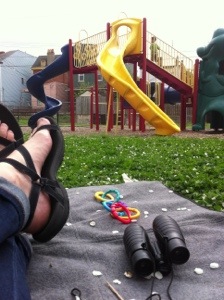
I’m looking for a few Cincinnati families to contribute to a blog series this summer called “Where We Play.”

20140505-115912.jpg

You’d be responsible for reviewing a Cincinnati-area park or playground and allowing me to post your review on the blog. I’ll give you a list of questions to answer. You’d also take a few photos to post with the review.

It would be credited to you as a “guest blogger” and I’ll gladly link to your blog, if you’d like.

Preference will be given to bloggers and playspaces near the city center, especially lesser-known and off-the-beaten-path spots. (Including Northern Kentucky.)

Email me if you’re interested and let me know where YOU play!

A Few Things This Season Of Life is Teaching Me


I take myself very seriously.
No, I take everything very seriously.
And the mental and emotional stress of taking everything so seriously is just unhealthy.

The past few months, I needed to slow down a bit, take a step back, and take a look around. Withhold judgement. Stop caring so much. Keep my mouth shut and chill out.

And it’s amazing what happens when you take the time to listen instead of always being the one doing the talking.


This season of life has taught me a few things.

Most recently, it’s taught me that the world does not stop spinning when I stop talking.

You know what happened when I took a break from blogging? When I withdrew from Facebook? Heck, when I withdrew from church and my neighborhood and friends?

Life went on without me.

Conversations continued and people had good ideas and bad ideas and talked about important things and not-so-important things. And it didn’t really make much of a difference that I was no longer contributing to the conversation.

For someone like me, someone who is just oozing with self-importance, the experience was both liberating and frightening.


Those of us who have even an ounce of smarts or talent or sense of humor have a nasty habit of believing–deep down inside where no one can see–that we are God’s gift to the world. (Please tell me I’m not the only one with this problem?)

But one of the greatest lessons that I’ve been learning over the past few years is that the world does not need me.

It doesn’t need my music. It doesn’t need my clever party banter. It doesn’t need my self-indulgent photos of my children. And it sure as hell does not need my controversial “oh my gosh I can’t believe she posted that” internet links.

And, like I said, this realization is both liberating and frightening.


It’s frightening because it questions my sense of purpose and my place in the world. If I’ve always defined myself as a songwriter or a class clown or a this or that or the other thing, when I realize that the world is already inundated with every this, that, and the other thing, it threatens my importance. It threatens my identity. It makes me self-conscious and defensive and then makes me either cowardly or pretentious.

But, this realization is also liberating. It’s liberating because it takes away the pressure to perform and the pressure to always be the one to make things happen. It frees me from the lie that the future of the universe is resting on my shoulders. And it frees me to appreciate the ways that other people are filling the voids that I leave. Because, you see, it’s hard to notice other people when we’re constantly obsessed with our own brilliant contribution to the world.


Step back for a moment, shut your mouth, and watch the world spin on without you.
You’d never believe how small it makes you feel.
And how good it feels to feel so small.


I still haven’t figured out what this all means or what I’m supposed to do about it. And I’m definitely not ready to move on from this season of my life. But there is one thought that’s been ringing in my ears the past few months, something Saint Paul said in his letter to the 1st-Century church in Corinth. The basic gist is this: It doesn’t matter how spiritual I am, how wise I am, how holy I am, or how impressive I am. If I have not mastered the art of loving, then I am of no use to the world. I am just another noise in the crowd and it is all for nothing.

The world doesn’t need one more self-important internet celebrity or smart-ass cultural commentator. So, until I’ve figured out how to love–my God, my husband, my children, my neighbors–then I’d be better off keeping my mouth shut, regardless of how pretty the song or how funny the joke.

There’s already enough noise in the world.
And not nearly enough love.

Are You Prepared?

Truth be told: I have survivalist tendencies.

I don’t speak a lot about preparedness because I don’t want people to see me as a weirdo Doosmday Prepper, building a bunker in my basement and storing ammunition under my bed. (I am doing neither of those things, btw.) I am a planner by nature. So, emergency preparedness is a manifestation of that need to plan ahead and be prepared for any situation, especially now that I am a wife and mother and have more than myself to take care of.

I think my interest in survival scenarios started young. While some of my female peers were reading The Babysitter’s Club, I was reading books like Hatchet. When I was a bit older, my taste gravitated more toward dystopian apocalyptic literature and movies. Then, when I entered college, more toward outdoor survivalist and adventure stories. The “What would I do in this scenario?” question has always been exciting for me. When I had my first child, I developed a lot of post-partum anxiety. So, my natural need to feel prepared has been both a blessing and a curse.

Living in a city, we take for granted the fact that we can get anywhere we need to get, to get anything we need, at any time. But we should know better than that. I have no desire to breed fear or anxiety in other people (because, Lord knows, I have enough for myself), but do you ever stop to ask yourself, “Are you prepared?”

Enter, the Polar Vortex.

Now, I am a Chicagoan by birth, so cold weather is not new to me. And, in general, I handle the worst of Cincinnati’s weather pretty well. But I will admit that there have been a few really cold days this winter and it appears that some more is headed our way. When extreme weather hits, it has ripple effects that run through all aspects of our lives. In the past two months, around the country, we’ve read story after story of the effects of extreme cold, ice, and snow: cars stalled, traffic stopped for hours, huge highway pileups, water pipes bursting or freezing, electricity down, busses stranded, etc.

And how about the recent chemical leak in West Virginia? Did you hear about it? We were lucky to be a large municipality, far from the leak. But, still, the City of Cincinnati had to close off intake valves from the Ohio River and use stored, treated water for a day while the hazardous material floated past the city. What if you were one of the 300,000 people further up river who had no drinking water because of the crisis?

Now, consider hurricanes, floods, extreme heat, earthquakes, tornados. These are just the natural disasters.

What if you had no access to the public water system for 24 hours? 48 hours? 72 hours?
What if your heat went out? Or your electricity?
What if your city closed the roads for three days and the grocery stores couldn’t receive deliveries?
What if you couldn’t leave your home for a week?
Or what if you absolutely had to leave your home for a week?
What if you only had an hour to leave?

These are questions we don’t like to ask because they make us feel powerless and vulnerable. But we have to ask them because we are powerless and vulnerable. And, if we don’t ask them, then we stay powerless and vulnerable.

Part of dealing with my anxiety has been reconciling my powerlessness and relinquishing control over things I cannot control. The other part? Being reasonably prepared.

There are four phases of preparedness.

Immediate.
This is preparation for a sudden, local emergency like a power outage or public water loss. It also includes car emergencies like being stalled on the side of the road or being stranded away from home. A good estimate of time for supplies is 72-hours. Preparations include simple emergency kits for on-hand at work or school, and in vehicles. Basically, if you were stranded in your house or in your car or in your office for 1-3 days, what would you need to survive?

Extended.
This is preparation for a few weeks of limited access to resources in times of civil unrest or after a disaster situation like a tornado. Preparations are usually as simple as keeping bulk supplies of what would normally be found in a functioning household, including water for drinking, cooking, and bathing. This would also include short-term evacuations.

Long-term.
This is where we get into the real “prepper” scenarios that make for tv-worthy entertainment. This goes beyond a few weeks’ worth of supplies and veers into months’ to years’ worth of stored food and sundry items, alternate sources of water and heat, and means of protection (i.e. firearms and ammo). This phase also considers long-term evacuation situations. Think: New Orleans, post-Katrina.

Perpetual.
People who enter this phase of disaster preparedness are generally preparing for a complete collapse of society, lone-wolf survival, and living off-the-grid. Have you seen the show Revolution? Imagine yourself in that America.

As much as survivalism and emergency preparedness fascinate me, I have not ventured much past those first two phases of preparedness that I outlined above. I’m just not convinced that there is an urgent need. So, I’m definitely not suggesting my friends cash in their IRA, buy a dozen acres, and bury a bomb shelter for the apocalypse. But, there are simple, affordable ways to prepare for potential emergency situations and it surprises me how few of my friends (especially those with children) haven’t even considered doing it.

The American Red Cross has a pretty good list of resources and tools for emergency preparation. This is probably a good place to start if the concept is new to you or seems overwhelming.

Like I said, I don’t talk too much about emergency preparedness because the “Prepping” world is a bit of a freak show that I’d rather not associate myself with. But, I think I have a responsibility to protect and provide for myself and my family in an emergency situation. It’s not quite as simple as keeping a few extra batteries and boxes of cereal in the house, but it’s also not as difficult as you may think.

Consider it.

(I’m happy to post more online resources if anyone is interested.)
Read this: News from Elsewhere

A few excellent articles worth sharing:


1. Here’s How Much Money You Must Earn To Buy A Home In 25 Big US Cities via Business Insider

Although this doesn’t seem to take into account the enormous amounts of debt and extravagant living expenses of most Americans, it does point to the fact that homeownership is relatively affordable for most of us. In Cincinnati, where the average home is just over $100k, “the American dream” is well within reach.

2. Pigs and Chickens Save Struggling Kansa School via World

I might not be a fan of standardized schooling, in general, but I could get behind an agricultural-based school. I wonder what this would do in an urban setting in the Midwest?

3. Chicago Aims to Beat Detroit on Horse-Drawn Carriage Ban via NextCity

Our city has a few horse-drawn carriages in the Central Business District and, as a downtown resident, I’ve heard varied opinions about them. This article offers an interesting discussion about the issue and how it’s playing out in two other cities.

4. The Yuppie Price Index for Services via Locality

Cincinnati was not included in this list (I wonder why?), but it’s interesting nonetheless. What exactly does it cost to be a yuppie in this city?

5. The Case for Big Cities, in 1 Map via the Washington Post

In 31 states, one or two metro areas account for the vast majority of economic output in the state.  Those numbers make clear that while you may like to hate on big cities, you — and we — need them.

It’s hard to ignore such striking facts. I would love to see one done on a local level. There’s got to be some Cincinnati-based data analyst willing to put together a similar study (and infographic!) for our region…


Enjoy!


Why I’m Thankful for Winter

What is it about winter that makes me feel so reminiscent?

Everything slows down. The nights are longer. And there seems to be more – s p a c e – for quiet and contemplation. Now, with three kids, space is generally pretty limited. (As is the quiet.) But the past few weeks have found me trapped inside my mind more than usual, thinking about the past.

On February 21, 2004, I stepped foot in Cincinnati for the first time. It’s an easy date to remember because it was the day after my brother’s wedding. And I’m glad I can remember it gives me a timestamp for that monumental day.

You see, at the time, February 21 didn’t seem so monumental. It was cold and I was visiting a good friend who was to become my boyfriend and I thought Cincinnati was pretty cool. But nothing about that weekend could have prepared me for all that would happen in the next few weeks, the next few months, and the next ten years.

It was winter. And, in winter, everything feels slow and quiet. So slow and quiet that you’d never know what’s actually happening under the surface.

The truth is that winter is alive, even if it looks like it’s sleeping.

Winter is like the calm before the storm
or the silent, early stage of labor
or the kettle of steaming water just before the whistle.

We cycle through the seasons every year but, for some of us, “winter” (in the proverbial sense) can last much longer. When I first arrived in Cincinnati, I was deeply imbedded in one of those winter-y seasons of my life. At the time, the cold, dark, and quiet of February 21st were apropos. And that cold, dark quiet stuck around for quite some time.

But, speaking literally, I’ve always loved winter.
I love winter because, even though the ground is frozen solid, there is magic underneath it all. It’s the kind of magic you can’t see, hear, or smell because it’s hidden until the ground thaws.

Why am I thankful for winter?
I’m thankful for winter because winter ends. And, when it ends, I’m reminded that every winter ends.

There is a storm brewing,
that baby is about to be born,
and you will hear the steam whistle.

We know this because storms and babies and hot cups of tea have all happened before and we can trust that they will happen again.

Lately, I’ve spent a lot of time looking back on my first few years in Cincinnati. At the time, I could have never known how monumental those years would be and what I would find at the other end. But, looking back, there were markers along the way that I simply didn’t have eyes to see.

If reminiscing involves looking back for the subtle hints we missed the first time around, then faith involves looking forward to what we have every reason to believe lies ahead.

After the ground thaws.
When the lightning crashes.
When our baby lets out that first cry.
When we finally warm our hands on that piping hot cup of tea.

Winter is a lot like the still railroad track the moment before it starts to rattle.
Maybe faith is something like holding your ear to the rail.

Are you listening?

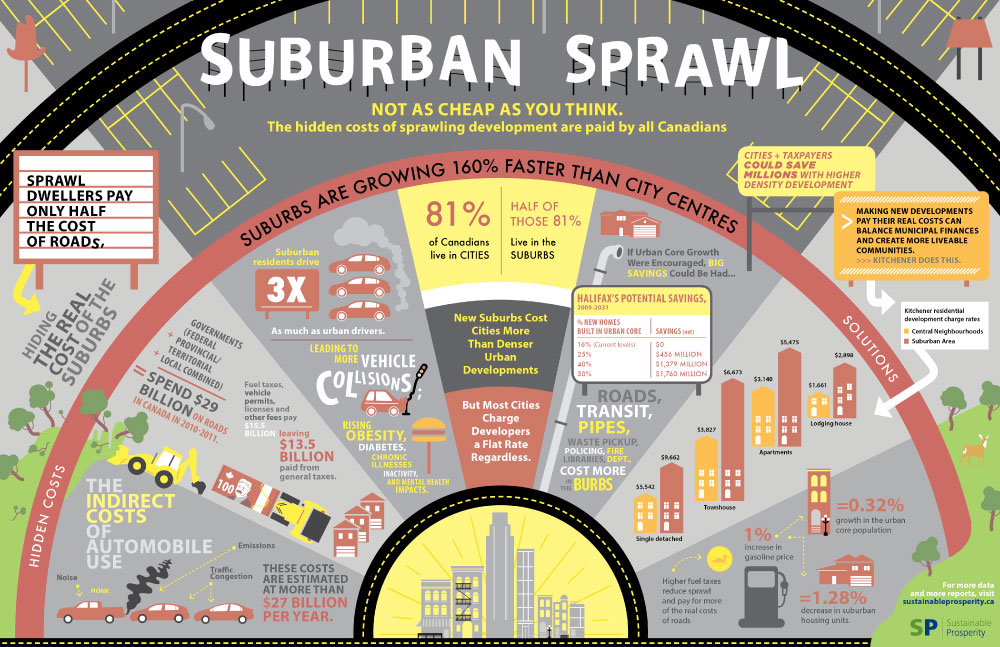
The Hidden Cost of Sprawl

I came across this link on Twitter (via @brenttoderian) and had to share it here.

infographic1000It’s a Canadian study on the hidden costs of suburban sprawl and it reveals the economic stress sprawl puts on all citizens, both those inside and those outside of the city:

While a suburban mortgage may look cheaper, it’s perpetuating a problem for municipalities, businesses, and taxpayers.

The report can be found at thecostofsprawl.com and I’d love to know if there is another study with US-specific statistics. Preferably one with an awesome, user-friendly website like this one?

Can someone send me a link?