Where We Play: Eden Park

photo from historylines.net

Eden Park– Walnut Hills

* This a guest post by Steve Carr, a husband, father, and pastor in Walnut Hills. Visit him online here.

Overview: Eden Park, located in Walnut Hills and bordering Mt Adams, is one of Cincinnati’s most popular parks. Yet those who visit often miss out on the wide range of opportunities hidden throughout the park. It occupies a strip of land between two hills overlooking the Ohio River Valley and boasts ample open spaces, trails, and numerous water features.

A system of paths connect the divisions of the park. Starting at the south end of the park (at Mt Adams Drive) is the Playhouse in the Park. Behind the theater is a “mini-park” area with a CRC pool. Descending the hill, you encounter the Art Museum and (down the hill) the Seasongood Pavilion. Behind the pavilion is a path to Mirror Lake, a popular walking destination. From here you could descend down the hill toward basketball courts and the remnants of the old reservoir wall (bigger kids love climbing up the incline of the wall since they’re practically steps). Usually, people opt to ascend the hill toward Krohn Conservatory. While the conservatory now charges an admission fee, it’s still an incredibly popular Cincinnati destination.

At the northern end of the park, up the hill from the conservatory, is the Twin Lakes—a place where children can feed the ducks and play on the playground. Yet this isn’t the end of the park, as you can ascend even farther up the hill toward the Eden Park Water Tower and scenic Author’s/President’s Grove. From there, you can cross the Arch Bridge to the Overlook, one of the park’s many scenic vistas.

General Cleanliness: Despite the high-traffic throughout the park, it is often very clean. The Twin Lakes area is a popular Sunday picnic location so it’s most chaotic then.

Parking: Parking is available throughout the park. If you decide to explore areas up the hill and don’t want to walk, you can move your car. If you decide to visit the Art Museum, you can save money by parking on Mt Adams Drive and taking the short walk to the museum.

Bathroom Facilities: Yes, in two locations: next to the parking at Mirror Lake and by the Twin Lakes at the top of the hill.

Picnic Areas: There are designated areas throughout the park. Still, the Twin Lakes tables are the most popular destination.

Playground: There are two playgrounds in the park. The most popular one is located at the Twin Lakes and was recently renovated. The lesser known playground is by the pool by Playhouse in the Park and is a great place to let smaller children explore a play set without getting trampled by older children.

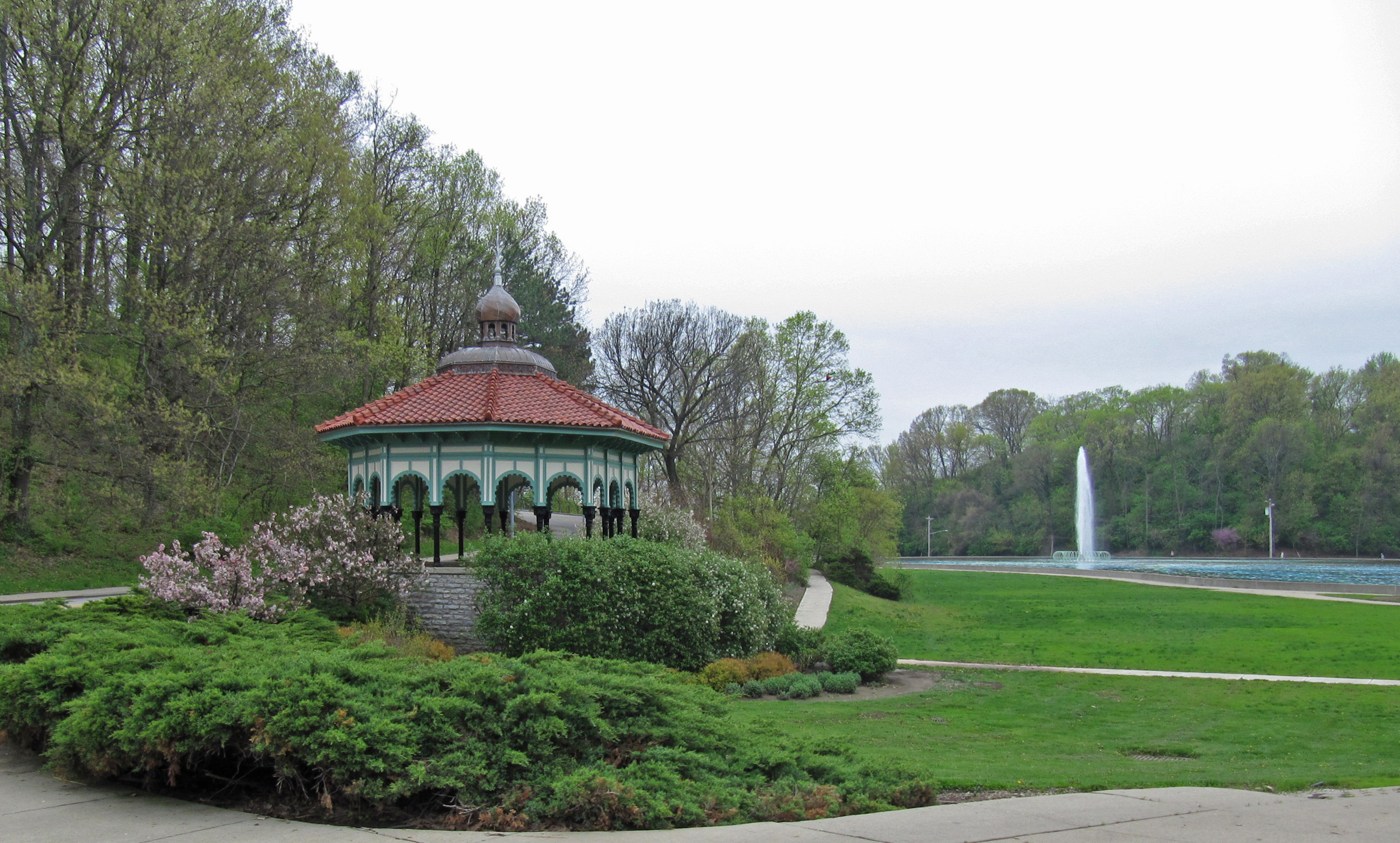
Other Amenities: The Gazebo by Mirror Lake is very popular. There’s now a paved walking path leading from there up to the Magnolia Grove which is another hidden gem. You could visit this park over and over again and have a new experience on every trip.


Look for a separate review of Eden Park’s Hinkle Garden in a future post!

*This is the fifth in the “Where We Play” series. If you’d like to contribute a park review as a guest blogger, send me a note at ejmcewan@gmail.com.*

The Blessing of Daily Bread

A little more faith talk for you.


Growing up Baptist, the Lord’s Prayer was familiar to me, but not a part of my daily life. Now, for the past few years, my husband and I have begun praying the words of that prayer every night with our children at bedtime. It is, after all, the way Jesus taught his disciples to pray. So, even if we know that there is nothing magical in the words themselves, internalizing the content of the prayer is important to understanding the proper way to frame our own prayers.

How many times have you prayed (or heard) the Lord’s Prayer without actually considering the implications of asking God for “our daily bread?”

The idea of daily bread was significant for those who heard Jesus’ words on the day he delivered the Sermon on the Mount (which includes the Lord’s Prayer). For generations, the Israelites had passed down the stories of how God provided for them in the wilderness with “bread from heaven,” the manna that lasted just long enough to be consumed and wasted away if hoarded for the next day. (For a good, quick discussion of the Biblical concept of “daily bread,” you can read this post by R.C. Sproul.)

When we take Jesus’ example seriously and ask for daily bread, we are truly going out on a limb. The implication of that prayer is that we will trust God to provide, daily, what we need. Nothing more. Nothing less.

And, sometimes, that’s exactly what he gives.

Daily bread.

Nothing more.
Nothing less.

I don’t know about you, but I’ve been well-acquainted with “bread from heaven” during certain seasons of my life. And even if the depth of “need” that I’ve experienced in my life is minor in comparison to the depth of need experienced by others next door, down the street, or around the world, that desperate feeling of neediness is the same. And our response–our posture toward God–really should be the same. “Give us this day our daily bread…” Whether that translates as a new job, next month’s rent, or (literally) food for tomorrow, these are the moments when faith is tried. And when we have to ask whether we really believe God is waiting at the other end of that prayer, poised to rain down bread from heaven.

Desperation.
Have you ever felt it?

Have you ever been in a place where you knew that a miracle–even a small one–was what stood between you and your next meal, next car payment, next pay check, or next doctor’s bill?

And have you ever considered that these seasons of living on daily bread are actually a blessing?


Living on daily bread gives us perspective on the difference between want and need.

Have you ever noticed that the less you consume something, the easier it is live without it? Spending money is a habitual behavior. For some of us, it’s an addiction. But when we simply cannot have something we want–a nicer car or an updated kitchen, for example–we realize (eventually) that we are fine without it. With some heart-work, our desires start to diminish and we gain a new perspective on what we truly need. (Spoiler: it ain’t much.) And when we know how little we truly need, God surprises us with the enjoyment of its simplicity.

Living on daily bread re-orders our priorities and proves what we value most.

When we’ve learned to live without many of the things we desire, the way we spend the money we do have says a lot of about what we value. Have you noticed that (with exceptions, obviously) the demographic most likely to invest their livelihood in raising a large family is the demographic with the least amount to invest? Have you ever asked why people would rather adopt another child or pay for someone to attend college or loan a stranger money than take another European vacation? Priorities. Show me how you spend your money and I’ll tell you what you value most.

Living on daily bread teaches us when “enough is enough.”

Once we are able to re-order our priorities, we get a better picture of what is enough for us and for our family. And we learn when to quit reaching for more. This is what motivates a man or woman to relinquish their “earning potential” and turn down a promotion or a high-paying job so that they can spend more time with their kids or serving their community. It’s that moment when we stand before the shiny, new things that we could have, and say to ourselves, “No, this other one is enough; I’ll be happy with this.”

Living on daily bread saves us from the delusion that we are self-made men.

Independence and security are counterproductive to a life of faith. I really believe this. The rugged individualism that builds nations and corporations and mega-churches is the same thing that blurs our vision of the difference between God and man. Who really holds the cards here? I don’t care if you are a millionaire or a beggar. Unless you are aware of your own inability to “make things happen,” then your faith is in yourself, not in God. You still believe that if you play your cards (or the stock exchange or the real estate market) right that you’ll be able to store up enough “bread” to last a lifetime. But, we’ve been told: “do not lay up for yourselves treasures on earth, where moth and rust destroy and where thieves break in and steal.” Our investments should be in eternal treasures, things that spring from God and not from ourselves.

Living on daily bread cultivates contentment, which produces generosity.

Along with treasure, contentment is something else that comes from God and grows over time. Contentment is satisfaction with what he has provided for me, regardless of what he has provided for someone else. It puts an end to comparison and envy and, funny enough, it actually produces generosity. Once we are free from obsessing over the things we don’t have, we loosen our sense of ownership over what we do have. We share more. We give things away. We invite others to join in and enjoy the blessings we have received. Whether it be an extra hamburger at lunch or a million dollar donation, this is where it becomes obvious the difference between someone who feels entitled to their wealth and someone who feels indebted to God for it.

Living on daily bread keep us looking up to the One who provides.

When we know that everything we have comes as a gift from God, we begin to orient ourselves to him and not to the world. And then the daily bread that keeps us alive and well–our money, our homes, our skills, etc.–moves us beyond survival and into service. This circles back to our priorities, of course, as we begin to re-order our lives toward the Kingdom of God rather than our own kingdoms. And this is where God multiplies our blessing. Not for all of us in all the same ways, of course. But always to the same end.


I am still trying to learn to see the blessing in living on daily bread. My heart is still prone to want more and better and “what she has” and I am so, so very anxious about everything these days. But I am learning. And I understand more today than I did yesterday how precious are the gifts that rain down on me every single day. And, every night, as we pray that God would “give us our daily bread,” I mean it more.

In a few weeks, with my son officially beginning his first term of kindergarten here at home, our daily meditation will be the same each morning:

“Therefore I tell you, do not be anxious about your life, what you will eat or what you will drink, nor about your body, what you will put on. Is not life more than food, and the body more than clothing? Look at the birds of the air: they neither sow nor reap nor gather into barns, and yet your heavenly Father feeds them. Are you not of more value than they? And which of you by being anxious can add a single hour to his span of life? And why are you anxious about clothing? Consider the lilies of the field, how they grow: they neither toil nor spin, yet I tell you, even Solomon in all his glory was not arrayed like one of these. But if God so clothes the grass of the field, which today is alive and tomorrow is thrown into the oven, will he not much more clothe you, O you of little faith? Therefore do not be anxious, saying, ‘What shall we eat?’ or ‘What shall we drink?’ or ‘What shall we wear?’ For the Gentiles seek after all these things, and your heavenly Father knows that you need them all. But seek first the kingdom of God and his righteousness, and all these things will be added to you.” (Matthew 6:25-33)

This is what we’ll be working toward memorizing (and learning!) together this year so that it’s written on our hearts and minds.


The Modesty Problem

I know that summer is almost over, but this is a post that I’ve been meaning to write for months now and should probably get out of the way before the frost hits.

If you run in the circles I run in, the same subject comes up every year at about the same time. It’s actually a pretty familiar scenario to all of us who grew up in an even marginally conservative culture. It goes something like this: It’s spring. Bathing suits and shorts hit the shelves. The weather shifts. Clothes get shorter, smaller, thinner (seriously. have you seen the obscene high-waisted shorts kids are wearing these days!?)… and then we start to hear the “m” word again.

Yes, Modesty.

Ah, modesty.

I could probably write a pretty comprehensive (and, literally, exhaustive) post about my thoughts on the issue and my history of struggling back and forth (and then back and forth again) with the implications (and definitions) of “Biblical modesty,” but I’d rather not do that here. Modesty and lust (which I’ll address here in a second) are very complicated, very personal, and very divisive subjects and I’d rather avoid too much complexity. So, I’ll keep it simple and offer a few observations about the issue of modesty. Specifically, I’ll speak mostly about how it’s addressed in conservative circles and some of the glaring problems I see in our conversations about it.

(If you’re not a Christian or somehow have avoided all the modesty talk in your world, this might all seem like hogwash to you. If that’s the case, be prepared to be amazed at how boring I can make a discussion about breasts.)


1. Modesty is not a sexuality-specific issue.

Almost every single time you read about Christian concepts of modesty, it’s presented in the context of sexuality, sexually-explicit (or simply revealing clothing), and how an immodest woman contributes to the sexual lust of men. Sure, the Bible clearly addresses issues of sexuality. But, speaking about only the sexuality-specific implications of immodesty is a case of addressing the symptoms and ignoring the disease. A proud heart makes an immodest woman. And a woman can be just as proud of her diamond ring, brilliant mind, or beautiful children as another woman is of her cleavage. A woman can clean herself up and make herself appear modest and presentable, but her pride will manifest itself in a different way.


2. Lust is not a sexuality-specific issue.

A greedy heart makes a lustful man. If all we address are the sexual implications of a greedy heart–one that simply must have that woman as his own–then we are really missing the point. Contrary to popular belief, there are men whose thirst–whose lust–is for money, for power, and for fame much more than it is for women and the object of man’s lust will change as he grows and changes. Greed, desire, sexuality, and power are so much more complicated than we are willing to admit. But, we have to admit it. Talking about a man’s craving of a woman’s body as the be-all-end-all of “lust” is simply not telling the whole story.


3. Modesty and lust are related, but they do not have a cause : effect relationship.

Because Christians are obsessed with sex (or so it seems), we tend to glorify the relationship between sexually-explicit women and dirty-minded men. But we (should) know better than that. A proud woman will be immodest in whatever area she most glories in and, likewise, a greedy man will seek to own anything he desires. Modesty and lust are related, but they do not have a cause : effect relationship. I am not responsible for a man’s lust and he is not responsible for my immodesty. We can see how the two things play together and feed off of each other, but we can’t blame them on each other.


4. Regardless, it does not really matter.

If a tree falls in the woods and no one is there to see me flaunting my breasts, I am still flaunting my breasts and am guilty of sin. (Get that?) Sin is sin is sin. My sin doesn’t get less sinful if there are no implications apart from my own sinfulness. We like to act as if Godly women can just brush off their own self-love and pride once they’ve realized that they’re not responsible for the sinful desires of men, but it cannot be done. A sinful heart is a sinful heart. Both men and women are accountable for their sins, regardless of how they do or do not affect other people.


5. Immodesty is not a woman-only issue; lust is not a man-only issue.

Bear with me here.
Up until this point, I’ve used the “immodest woman” vs. the “lustful man” paradigm because it’s the most common paradigm we see (and discuss) in Christian circles. I’m comfortable doing this because I believe (unlike many of you, perhaps?) that the most common (or most natural) tendency is for women and men to gravitate toward these two sides of the paradigm. But I understand that it’s more or less a stereotype–true enough to use as a baseline for argument, but not true enough to be a plumb-line. So it should be said that, if what I’ve said above is true and modesty and lust are about much more than sexuality, then immodesty is not a woman-only issue and lust is not a man-only issue. The interesting thing here is the way we can see both immodesty and lust play out in both men and women, almost completely independent of each other.

Most of us are self-aware enough to be able to tell you our strengths–mental, physical, sexual, whatever–and most of us are also aware that we can objectify those strengths and use them as a means to end. Tell me I’m not the only one who has noticed how many movies and television shows make play of women flashing their chests or pouting their lips or batting their eyes or faking tears to get what they want. Well, this skill is called manipulation (or sometimes “the power of suggestion”) and most women know how to do it and if they don’t have the legs to get it done, they’ll find something else just as powerful–a brilliant mind, a quick wit, or maybe a superb talent. Some women lust after the attention (or affection) of men, some lust after power, some lust after success. It just so happens that what is most available and efficient to get the job done is usually their physical appearance if not, specifically, their sexuality.

And men aren’t off the hook when it comes to immodesty. Take, for example, the “trophy wife.” This phenomena is not a sterotype of a bygone era, but is a manifestation of not only a man’s lust for success, but also his compulsion to show it off. It might not be a woman. It might be a $40,000 sportscar or a “Ph.D.” or a VIP award in the softball league. It doesn’t matter. What matters is that once pride takes root, immodesty makes a man parade his wealth/success/power/achievement around for all to see.


6. But it’s so much more complicated than this.

Let’s be honest: Some women are just shockingly beautiful. And some men are smashing successes. Some of us sing like angels and some can solve complex mathematical equations and some of us breed child prodigies. And these are good things. And they are meant to be enjoyed, by both us and by other people. And although my (admittedly horrendous and sinful) tendency is to be judgmental of women and how much skin or leg or new shiny thing they show off in public, it is impossible for me to know the heart of another woman (or a man) unless I’ve been made privy to that personal information. Our job is not to judge the intentions and motivations of others, but to keep our hearts in check instead. And then to find people who we can know and be known by to such a degree that there is freedom to revel in (and truly enjoy) each other’s strengths and gifts. When we know each other–deep down in the hearts of each other–we don’t have to spend time judging intentions and motivations because the things we love about ourselves and other people become simply a part of who we are and not objects in and of themselves. This is what community looks like. This is what the Church should look like. Loving each other this way keeps us from objectifying ourselves and others and the things we want and gives us appropriate places to enjoy the things we love.


7. Which is why marriage is so good and so important in its relationship to modesty.

I hope this doesn’t seem like a far stretch because it’s pretty crystal clear in my mind.

A healthy marriage is the perfect, most appropriate place to exercise a woman’s desire to be seen, known, and loved (which so often leads to immodesty) and a man’s desire to see, know, and possess (which so often leads to lust). In a way, a Godly marriage redeems these desires by harnessing them into a mutually giving, sharing, and reciprocal relationship–especially, but not only, sexually. No marriage is perfect, but good marriages are built on solid foundations. If a marriage exemplifies the “community” I described above, one in which two people know each other and are known by each other deeply, then there is freedom to enjoy and not objectify ourselves and each other. A good marriage liberates us from the need to seek attention and affection elsewhere. And where a marriage lacks, when perhaps a couple struggles to meet each other’s mental or emotional or spiritual need to see and be seen, that’s when the rest of the Church comes alongside and provides an appropriate place or person to fill the void.


8. The reality (and the power) of immodesty and lust in our lives and in our world requires action.

In a perfect world, where we all had pure hearts and pure intentions and only the purest of thoughts, men and women could parade around the street in all their naked glory, boasting of their recent pay raise and showing off their perfectly-behaved children. No one would judge; no one would be jealous; no one would feel worse for what they, themselves lack.

But we don’t live in that world.

In this world, we have to learn when and how to cover up. Because it’s not necessarily about what we’re wearing or how we’re wearing it, but sometimes it is about why we’re wearing it (or not wearing it). And it’s not because we’re responsible for a stranger’s lust, but because we’re responsible for our own pride and compulsion to be seen. And, if we didn’t feel the need to be seen, we would be willing to wear anything.

We learn when to keep our mouths shut. Not because we don’t have anything valuable to say, but because it’s not always necessary to be the one speaking.

And, in this world, we need to learn how to keep some things to ourselves. (Even some of our best or funniest or brightest things.) Because the love and admiration and attention of a friend or stranger is nothing compared to the love we’ve already been shown.

Maybe modesty is less about how much we cover up or shut up or keep to ourselves and more about subtly, humility, and appropriateness.
We need to learn to be okay not being seen, or heard, or loved sometimes so that we can learn to see, hear, and love someone else instead.
 

Where We Play: Burnet Woods


Burnet Woods– Clifton

Overview: My introduction to Burnet Woods was through leading field trips as an educator with a local nonprofit. During the field trips, we stopped for lunch and a program at the Burnet Woods’ Trailside Nature Center, which is positively one of the hidden gems of our city. The park itself is 90 acres and includes multiple amentities, including the nature center which is (as far as I can tell, and am sorry to report) rarely open to the public. It’s the perfect stop for a quick hike near to downtown and is easily accesible by foot or by car from the Uptown neighborhoods of Corryville, CUF, Avondale, and Clifton.  We’re there a few times a year and the last time we went–as evidenced by the photos–was prime season for wildflowers and mulberries!

General Cleanliness: A few littered spots in the high foot-traffic areas. The trails are not super well-maintained, but it only adds to the “wild” feel, which I actually prefer. Some areas could use updating. (There has been a lot of talk about proposed improvements to the park.)

Bathroom Facilities: Yes, though I’m not certain of the open hours. According to the park map, there are three separate facilities.

Picnic Area: Multiple picnic areas, including covered shelters and a gazebo.

Parking: Street parking is available along the edges of the park and on a few access roads. There is no central parking lot.

Playground: There are two playground areas that I know of: one, near the nature center, with an older set of swings and a fantastic concrete slide; one near the Clifton Ave. access point with a more modern play structure. (Our usual hiking route takes us from one to the other and back again.)

Other Amenities: Our favorite parts of the park are definitely the concrete slide and the hiking trails. The nature center, as I mentioned, is worth the trip if you can figure out when it’s actually open. There is also a Stonehenge-style sculpture that we’ve never seen in person, though it’s visible from the road. And the pond is a very popular place for visitors.


*This is the fourth in the “Where We Play” series. If you’d like to contribute a park review as a guest blogger, send me a note at ejmcewan@gmail.com.*

Where We Play: Queensgate Playground

Queensgate Playground – West End, on Court St


* This is a guest post by Emily Benhase.

Overview: This is our neighborhood playground, less than a block from our house, so we frequent it often when the weather is nice. The city recently finished putting in two new (and very nice) play structures, as well as a set of swings. Plus there is enough open green space that I feel comfortable letting my children run free without having to worry about traffic. There are almost always other neighborhood children there, so it’s a great place to interact with the community and meet new people. It’s also close to the Lincoln CRC Pool as well as the Museum Center and would make a great place to have a picnic before or after a visit to either of those places.

General Cleanliness: overall fairly neat, especially the newer section. There is sometimes a little trash on the ground.

Bathroom Facilities: no bathrooms on site, although there is one portable restroom.

Picnic Area: There is one picnic table near the older playground and one near the new playground, as well as a lot of grass (some under trees for shade) for picnics

Parking: street parking, free

Playground: There is a small, older play structure on one end of the park. The other end has a new, fairly large playground, with swings. There is also a smaller structure for younger children, as well as baby swings. In between the playgrounds is a baseball diamond and an open, grassy field, perfect for kicking around a soccer ball or tossing a football.

Other Amenities: Located near the new play structure is a charcoal grill, which I’ve often seen groups using on the weekends. And it seems to be a popular spot for cookouts and birthday parties this time of year. There is also a line of trees that look perfect for climbing!


Thanks, Emily!

*This is the third in the “Where We Play” series. If you’d like to contribute a park review as a guest blogger, send me a note at ejmcewan@gmail.com.*

Where We Play: Mount Echo Forest

Mt Echo Park– Price Hill

Overview: Mount Echo is one of Cincinnati’s lesser-known parks and is located just west of downtown, in Price Hill. Back when I worked in East Price Hill, I often stopped at this park for some solitude. But, to be honest, I don’t think I ever got very far out of my car. The view of downtown isn’t always the best from the westside–due to the industrial areas in Queensgate and Camp Washington. But, even if it’s not the BEST view of the city, this parks hosts a spectacular view of the Ohio river and Kentucky, as well. It seems like this park is easily accessible to a few subdivisions in East Price Hill and there were a few basketball and tennis courts and a baseball field that I can imagine are frequently used. We walked most of the park, but didn’t venture onto any of the wooded trails. Maybe next time!

General Cleanliness: Most of the park was clean and well maintained, but the main playground area was a total disaster. (I’m thinking–hoping–we just happened to be there the morning after a messy fast food picnic, before Parks staff could get to it.)

Parking: A few parking lots.

Bathroom Facilities: Yes, though we didn’t check to see if they were unlocked.

Picnic Area: A few picnic areas, including a really nice covered shelter, plus a few benches and lots of open grass.

Playground: One older plastic playground and a smaller area on the other end of the park with swings.

Other Amenities: The Pavilion is really neat, as is the shelter. There are ball fields and playgrounds, as well as hiking trails. The open greenspace and overlook views are the strength of the park.


*This is the second in the “Where We Play” series. If you’d like to contribute a park review as a guest blogger, send me a note at ejmcewan@gmail.com.*


Related Posts:

Go Play Outside!
Go Play Outside: Alone?
Go Play Outside: In The Cold
Urban Families: How To Get Them & How To Keep Them
Where We Play: Lytle Park