Thanks to Soapbox Cincinnati for including me on the list of 18 local female bloggers worth following.
What a treat!
personal commentary on things like marriage, motherhood, education, community, urbanism, theology, culture, and politics
Thanks to Soapbox Cincinnati for including me on the list of 18 local female bloggers worth following.
What a treat!
So how, exactly, are we going to pay for the operational costs of our new streetcar system? That’s the question of the age in Cincinnati, isn’t it?
A few solutions seem obvious to me: rider fares, sponsorships, and minimal tax increases in the immediate area (known as a TIF district). Beyond that, I’m not city-savvy enough to even pretend to have any easy solutions.
A few weeks ago, Mayor Cranley made a seemingly off-the-cuff suggestion that the City simply charge downtown and OTR residents a couple hundred bucks a year for a residential parking permit and that those funds be used to operate the streetcar. I’m not going to waste time making judgements about the Mayor’s intent in proposing this solution. Instead, let me offer my perspective on the idea itself.
First, OTR absolutely needs a residential parking program.
This has been a topic of conversation for a few years now as the development in the neighborhood brings more and more non-residents into the neighborhood and as more employees need a place to park during open hours. On a personal note, the difference between the ease of parking four years ago and the situation today is nearly night and day. And with a 600-seat music venue opening around the corner, I’m preparing for a rude awakening for all of us in a few weeks.
The folks at UrbanCincy.com think that the Mayor’s idea is reasonable. (You can read the editorial here.) The basic gist of the editorial is that driving is already subsidized in many ways and that it’s reasonable to begin asking residents to actually bear the cost of their driving habits. They compare the average monthly parking rates in the area to market rates in other cities. And they suggest that this could be implemented city-wide with the funds being used for various developments in other areas.
I’m actually sympathetic to the idea of charging residents for parking permits and, in some ways, I agree with the UrbanCincy.com editorial. But I think there are a few errors here.
We know that the $300 suggested permit fee is hundreds of dollars above the yearly fees in other cities. Some might suggest that the lower fees of other cities are too low and that they don’t even come close to matching the current subsidies. But I argue that, even if that is the case, it’s still unreasonable. It’s unreasonable because it’s asking residents of our city, which is only now catching up to comparably-sized cities to pay exponentially more for the benefits found in cities that are steps ahead of us. It’s essentially asking us to pay 22nd Century prices for 20th Century amenities.
You might say, like UrbanCincy.com, that the $25 a month that it would cost is still significantly lower than the average monthly parking rate (on lots and in garages) in the neighborhood, which is about $89. Well, yes, you’re right. But that $40-110 a month pays for security and availability. My $300 would not guarantee me a spot anywhere near my home. It would simply guarantee a spot somewhere on a “resident-only parking” street in the neighborhood which, with increased meter hours on every other street, might not mean much at all. Heck, we can’t even find the means to enforce street parking restrictions and vehicle-related crimes as they stand now. Do you really think the city is going to work hard to protect my $300 parking space?
Now, if we’re actually suggesting that every resident in every neighborhood with publicly-funded transit (including road improvements) is going to be asked to pay the same fees, I would get behind that. But good luck getting city-wide resident support for a $300 yearly fee to park on city streets. A more reasonable fee that is comparable to other forward-thinking cities seems like a better idea.
Second, the Mayor was quick to suggest that low-income residents of OTR would not have to pay these fees. So, a couple living in a $300,000 condo (that did not already have a safe, convenient parking garage that they are willing to pay for) would pay the $300 fee and then any random resident who can prove they get mail at an OTR address but don’t make enough money to pay the $300 can park for free? Let’s assume that by “low-income,” we mean the standard measurements used for subsidized housing in OTR, which is essentially, those making less than $35,000 a year. (I talked about this more in a recent post about “affordable housing.”) But what about those making between $35,000-120,000 a year? You know, the working- and middle-class residents? There is a reason many of us don’t pay for monthly parking spaces: we can’t afford them.
I’m not one to throw the proverbial baby out with the bathwater, so I’m not willing to write off the whole idea. I do think the City should institute an official residential parking permit program. But I think the rate must be reasonable, attainable for middle-class residents, and must be instituted in all areas of the city where the City is paying for transportation improvements.
Lastly, let me speak from a mother’s perspective.
As much as I’m sympathetic to the young urbanist agenda for car-free, rail-strong cities, it’s important to remind everyone that a strong urban core must make room for families, not just empty-nesters, yuppies, and the childless creative class. Joel Kotkin who is always good at upsetting people with his views on urbanism, said it perfectly in a City Journal article a few years ago:
“In California, particularly, state and local officials push policies that favor the development of apartments over single-family houses and town houses. But by trying to cram people into higher-density space, planners inadvertently help push up prices for the existing stock of family-friendly homes. Such policies have already been practiced for decades in the United Kingdom, making even provincial cities increasingly unaffordable, as British social commentator James Heartfield notes. London itself is among the least affordable cities in the world. Even middle-class residents have been known to live in garages, converted bathrooms, and garden sheds.
“…Ultimately, everything boils down to what purpose a city should serve. History has shown that rapid declines in childbearing—whether in ancient Rome, seventeenth-century Venice, or modern-day Tokyo—correlate with an erosion of cultural and economic vitality. The post-family city appeals only to a certain segment of the population, one that, however affluent, cannot ensure a prosperous future on its own. If cities want to nurture the next generation of urbanites and keep more of their younger adults, they will have to find a way to welcome back families, which have sustained cities for millennia and given the urban experience much of its humanity.” – “The Childless City”
But, why does this matter? What is the correlation between parking and families?
Well, let me speak from personal experience: the logistics of raising a family in the city can be really hard. Particularly when you have to consider transporting multiple bodies and nightmares like unloading a trunk full of groceries with three kids in the car and no available parking spaces.
My children and I have definitely adapted to a semi-pedestrian lifestyle, can go days without hopping in a car, and are accustomed to walking a few blocks from car to front door. And my kids know no different. So, many of my childless friends think I should just get rid of the car and save myself the $300 and the bother of finding a convenient place to park.
It’s that simple, right?
Oh gosh, I wish it was.
Maybe for a family with 2 or fewer children; maybe with no family to visit in the suburbs and across the country; maybe without my husband’s side-work that requires complete mobility; maybe in a city that isn’t surrounded by hills that only an olympic cyclist could pedal with kids in tow; maybe in a city where ZipCar had vehicles that would actually fit a family (or even mentioned kids or carseats on their website!!); maybe in a city where any of my closest friends were actually willing/able to live in the urban core where we could walk to see them rather than drive.
But I digress.
Look, I’m not complaining. I knew what I was getting into when I decided to stick it out here, kids and all. So, let me clarify: I don’t think that true, urban living is ever truly “convenient” in the modern sense. And I believe, completely, that anyone can adapt to a pedestrian lifestyle which becomes more convenient in many other ways. But I think making car ownership an impossibility for so many of us, based on its cost alone, means cutting off a demographic that is too valuable to the city to lose.
There are some magical places in the world where a large family can live in the urban core without a vehicle–and without a $250,000 income. (Seriously, you’ve heard of this woman, right?) But we don’t live in one of those places. We live in Cincinnati, Ohio, which is still struggling to rally residents around the thought of a simple commuter lightrail line. Heck! It’s taken years to coerce one of the country’s largest grocers to open a legitimate urban-platform store in its home city!
Our urban ininfrastructure is far, far behind, my friends.
We may get there some day and I hope I’m here when we do. But we are not there yet.
And if we think that charging a few thousand residents $300 a year to park on city streets is going to usher our city into the next era of urban renaissance, we are wrong.
I think our attention needs to focus more holistically on creating a livable city for everyone–all incomes, all demographics–where people don’t just come for $10 hotdogs, but can actually live and shop and raise kids and open businesses in the same place where the Symphony rehearses and the Reds play.
This is the kind of city I want to build.
Not one for the elite; one for my children.
And a $300 parking permit might not seem like a huge deal in the entirety of the transit issue, but it’s just one more example of how the urban middle-class of our city may be destined for extinction.
And, if there is no place for the urban middle-class in Cincinnati, then maybe I’m in the wrong city.


Hiking and camping are two of my favorite outdoor activities and, in my opinion, fall is the best season for both.
If you live in Southern Ohio, both hiking and camping are available at multiple locations within just a few hours’ drive. This summer, our family took a quick three-day trip down to one of our favorite places in the region–the Red River Gorge. It’s technically a “geological area” with an impressive collection of canyons and natural arches located within the Daniel Boone National Forest. It’s only a 2.5 hour drive from Cincinnati, in Central Kentucky, which is the perfect distance to get outta town and go play outside.
On this trip, with our three kids in tow, we rented a cabin inside the Gorge (we used the rental company Red River Gorgeous), so we were only a short drive away from all of the trailheads. We also ended up with a cabin on a creek with bunk beds (!), which was the perfect place for the kids.
Campfire. Creek-dipping. Bunk beds. Perfect.
During our long day of hiking, we took a short hike up to Whistling Arch (which is where I almost had a mild heart attack watching my son climb in the arch with my husband). And then we hiked the 1.5 mile Rock Bridge loop. The kids got a little tired toward the end of the loop, but it was well worth the work and gave me a good idea of how resilient they would be on a longer-distance hike. (And gave me more experience carrying a 20lb baby on a descent/ascent.) We do a lot of rugged hiking locally, but new terrain is always good practice.
If you live in the area or feel like driving down to Kentucky for a new adventure, check out the Red River Gorge. Do it alone, or with kids, or with your favorite hiking buddy. Rent a cabin or bring a tent. (Backcountry camping will cost you a small overnight fee.) Bring a kayak for the river or your climbing gear for the canyons or your bicycle for the scenic roads. However you do it, find some time this fall to do it.
Go play outside!
Derailed.
How many times in your life have you been completely derailed from your intended path? Not the kind of derailing that drops you neatly off at your plan B, but the kind that pulls you off the track, spins you around, and leaves you stranded with no clear path in sight?
I was in college when it happened to me.
At the young age of 18, I was already certain of the path laid out before me and it involved a career in music ministry. Namely, it was me on stage at some big, fancy church, guitar in-hand, leading people in worship. To those unfamiliar with the world of Christian worship, the very notion of a music ministry career might seem odd. But, to me, it was everything. My faith was pretty mature for someone of my age and I had a pretty solid theological understanding of worship, so that was a good start. I loved singing. I loved church. (I loved singing in church.) I had just recently started playing the guitar and had dabbled in song-writing. I believed I had been given a set of skills that could be used to serve, not just attend church. Put it all together and a life working in ministry was the perfect fit. So perfect, in fact, that when I left home for college, it was to complete a degree in Worship Arts. (Yes, they have college degrees for that.)
And here I am, folks. The proud owner of a BA in Worship Arts. But, that career in music ministry? It’s nowhere to be found.
I’ll spare you the sordid details of the four years between the decision to pursue a career in music ministry and the decision to absolutely not pursue a career in music ministry, mostly for the sake of space. (I’d be happy to speak one-on-one, of course.) Instead, I’ll offer a quick walk through the journey that took me from almost- “rockstar worship leader” to, well, whatever I am today.
We begin.
First, I realized that working with and for Christians is really hard. Not hard because they are any worse than non-Christians but because they are so seldom better than non-Christians. I learned this quickly as a student at a Christian university. I’m sure my friends engaged in full-time ministry can attest to working with/for wonderful people, so this is obviously not true in all places and in all circumstances. But, for me, the reality of a lifetime surrounded by and working with Christians started to look a little disappointing. I wanted ministry work to be full of encouragement, drama-free and supportive. But people are people, after all, and even the prettiest people can look ugly sometimes. Right or wrong, I was a little shell-shocked when I realized that signing on for a life working in churches did not guarantee a peaceful work environment.
Also, after a year or two deeply embedded in what I’d call “contemporary worship culture,” I started to develop some serious issues with the music I was hearing and playing. Sure, it was fun to play. But what was it actually communicating about the nature of God and our relationship to him? I hadn’t really discovered “new hymns” yet and even though I was reading a lot of Robert Webber and completely bought into the concept of liturgical renewal and “ancient-future” faith, I hadn’t seen a lot of it in action. At least not by my peers. And at least not in a musical language that made any sense to me.
I was also struggling personally. My faith had always had a certain heaviness to it. And then, about mid-way through college, I entered a really difficult season of my faith. At the time, none of the options set before me seemed to speak to what I was experiencing, at least not with the depth I longed for. I actually got to the point where I had to completely disengage from leading because the words themselves seemed disingenuous, like lies. I felt like a fraud.
I valued honesty so much in life and in ministry that I couldn’t be a part of a culture where worship and truth seemed mutually exclusive. And it became clear that, if I couldn’t be honest in worship, I had no place leading God’s people in worship. I had never been good at faking it. The Church does not deal kindly with people like me–people who have a hard time keeping their mouth shut. And because I hadn’t quite figured out the appropriate venue or the appropriate way to address both my personal and ideological issues, I chose to simply step down and disengage from being a “public Christian” entirely.
Sometime around then, it became obvious that I also had no business being a celebrity–even a small-time, church-sized celebrity. I had no interest in having my face printed on the cover of a worship cd or my name appearing before the phrase “worship concert.” Even if my heart was in the right place–which, let’s be honest, could I promise that?–I couldn’t guarantee that the people worshiping with me were not, in fact, worshiping me or the music or the feeling they got when the bass drum kicked in on the second verse. Walking into the spotlight felt more and more like feeding Christian culture’s addiction to the “cult of personality” and the worship of super-Christians.
So, where do you go when you’re 3/4 of the way through a degree in Worship Arts, but you have absolutely no intention of continuing on into a career in ministry?
Well, I finished my degree, for starters.
I spent my last year focused on what I knew and loved about the history of worship and the Church, rather than what I found objectionable about contemporary worship culture. I wrote my senior thesis about, basically, the vapid nature of contemporary worship expressions and how they are insufficient for meeting our need for depth and honesty in worship. One of the implications of this insufficiency is that there is and will be a strong, post-Evangelical presence in the 21st Century Church, one that more closely resembles historic, Biblical expressions of worship and liturgy. (My paper was not nearly as articulate as that, as far as I can remember. But that’s basically what it said.)
After I graduated, I considered moving on to Graduate school to study the theology of worship even further, but I was still struggling so deeply in my personal faith that it just didn’t seem like a reasonable option. So, I found something else to do for a little while, to clear my head and let my heart and faith repair. I followed a boyfriend 300 miles to Cincinnati, Ohio and joined AmeriCorps, committing the next two years to full-time community service.
I starting writing more music, music that was decidedly not intended to be used as worship music (at least not in any corporate setting). It helped me heal a bit and reason aloud through my confusion at the complete derailment of my life. It provided the medium for honest expression that I couldn’t seem to find while working in an official ministry capacity. And it brought me together with many, many more people who had experienced the same thing as me.
I found safe places to worship. The first was an Anglican church in Wheaton, IL where I could be more-or-less anonymous, augmented by a Bible study with a small group of trusted friends when I couldn’t motivate myself to get to church on Sundays. When I moved to Cincinnati, it was a vibrant house church network where I was absolutely not anonymous, but I was welcomed–loud mouth and all–without any strings attached. These two places helped me rebuild my concept of worship and Christian community.
And, in small places and small ways, I started to dip my feet back into the world of ministry. I ended up married to an ordained Pastor, so that forced the issue a bit. But, even before that, I took small opportunities to help lead and administrate worship for God’s people when invited. I try to be always a step back, always a little hesitant, but willing to help when it seems prudent.
I explored the new frontiers of contemporary worship music, music that borrows more closely from Biblical expressions and Psalms, speaks more clearly about the nature of God, and leaves out the subjective “me and Jesus” talk that was so prominent in the worship music written when I was an adolescent. I learned to immerse myself in this music. These are the songs I wish I knew back when I was young and felt alone and without a voice in my struggles. I have also learned to give credence to various expressions of personal worship, when used in their proper context, even if they don’t satisfy my particular need.
And, in this current season of my life, I am trying to allow myself the enjoyment of reminiscing about that sweet time in my life when worship was less complicated and came more naturally from my heart. And to allow other folks–including rockstar worship leaders–to enjoy their ministry and worship lives without projecting my own personal baggage on them.
“Fear and trembling” are two words that come to mind when I consider my future role in the Church and how my gifts and skills can and will be used for ministry. I have no idea what the future holds and whether or not I’ll be derailed again and tossed into a different path. My husband and I are poised and ready to jump whenever the next step is evident. And I’m sure that what I’ve learned about myself, my own wavering faith and intentions, and the value of honesty in worship and community will help define my role. But I’m still so very unclear about what that role may be.
Safe bet: the future doesn’t involve me being a rock star.
Those days are, thankfully, long-gone for me.
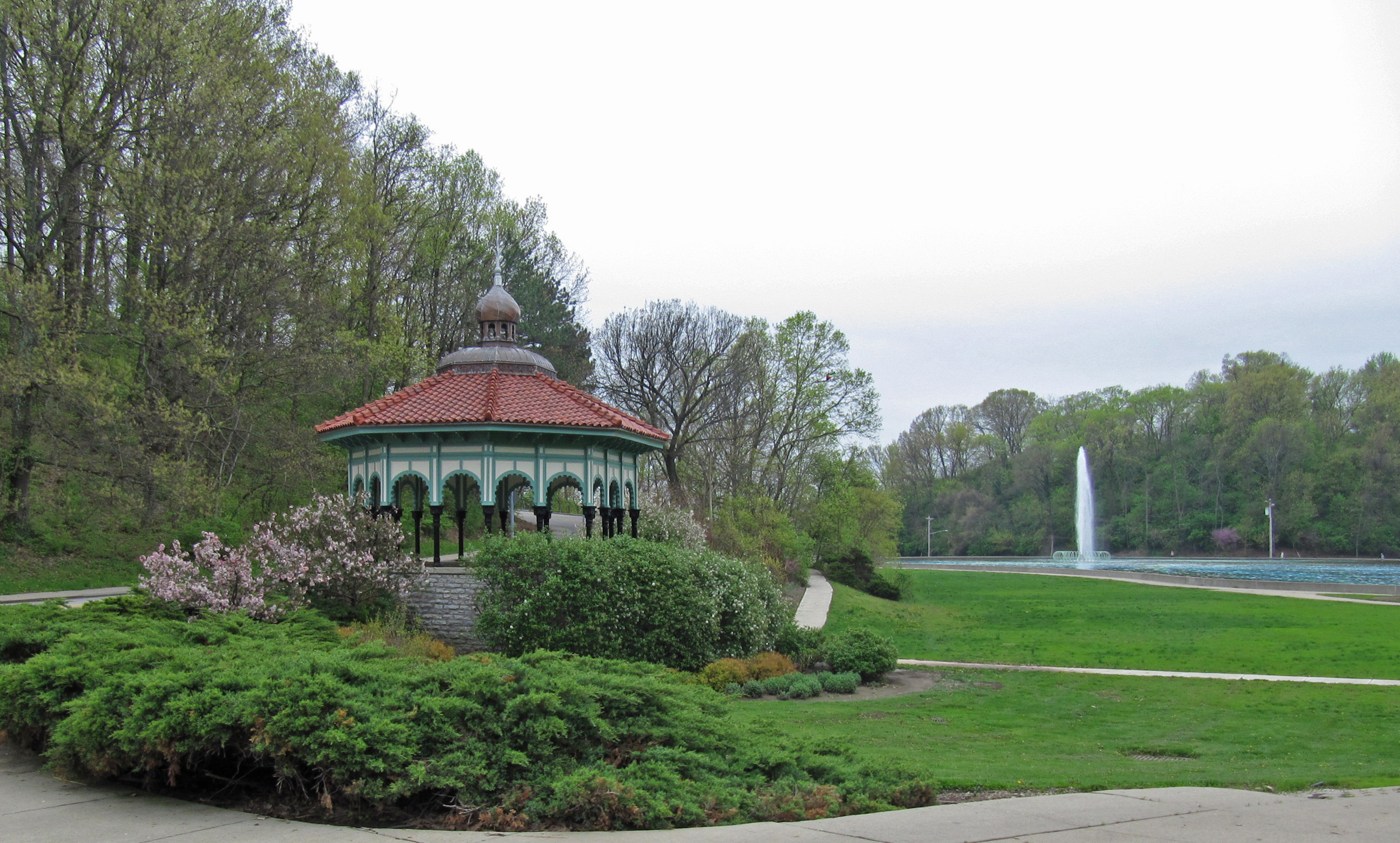
Eden Park– Walnut Hills
* This a guest post by Steve Carr, a husband, father, and pastor in Walnut Hills. Visit him online here.
Overview: Eden Park, located in Walnut Hills and bordering Mt Adams, is one of Cincinnati’s most popular parks. Yet those who visit often miss out on the wide range of opportunities hidden throughout the park. It occupies a strip of land between two hills overlooking the Ohio River Valley and boasts ample open spaces, trails, and numerous water features.
A system of paths connect the divisions of the park. Starting at the south end of the park (at Mt Adams Drive) is the Playhouse in the Park. Behind the theater is a “mini-park” area with a CRC pool. Descending the hill, you encounter the Art Museum and (down the hill) the Seasongood Pavilion. Behind the pavilion is a path to Mirror Lake, a popular walking destination. From here you could descend down the hill toward basketball courts and the remnants of the old reservoir wall (bigger kids love climbing up the incline of the wall since they’re practically steps). Usually, people opt to ascend the hill toward Krohn Conservatory. While the conservatory now charges an admission fee, it’s still an incredibly popular Cincinnati destination.
At the northern end of the park, up the hill from the conservatory, is the Twin Lakes—a place where children can feed the ducks and play on the playground. Yet this isn’t the end of the park, as you can ascend even farther up the hill toward the Eden Park Water Tower and scenic Author’s/President’s Grove. From there, you can cross the Arch Bridge to the Overlook, one of the park’s many scenic vistas.
General Cleanliness: Despite the high-traffic throughout the park, it is often very clean. The Twin Lakes area is a popular Sunday picnic location so it’s most chaotic then.
Parking: Parking is available throughout the park. If you decide to explore areas up the hill and don’t want to walk, you can move your car. If you decide to visit the Art Museum, you can save money by parking on Mt Adams Drive and taking the short walk to the museum.
Bathroom Facilities: Yes, in two locations: next to the parking at Mirror Lake and by the Twin Lakes at the top of the hill.
Picnic Areas: There are designated areas throughout the park. Still, the Twin Lakes tables are the most popular destination.
Playground: There are two playgrounds in the park. The most popular one is located at the Twin Lakes and was recently renovated. The lesser known playground is by the pool by Playhouse in the Park and is a great place to let smaller children explore a play set without getting trampled by older children.
Other Amenities: The Gazebo by Mirror Lake is very popular. There’s now a paved walking path leading from there up to the Magnolia Grove which is another hidden gem. You could visit this park over and over again and have a new experience on every trip.
Look for a separate review of Eden Park’s Hinkle Garden in a future post!
*This is the fifth in the “Where We Play” series. If you’d like to contribute a park review as a guest blogger, send me a note at ejmcewan@gmail.com.*
 the walking green