I’d be a millionaire if I had a dollar for every time someone has said to me, “Oh, I would love to raise my kids in the city, but…”
(Okay, maybe I wouldn’t be a millionaire, but I would have a decent wad of cash.)
There are two sides to the “urban family” paradigm. There are the things we choose to live here for. These are the inherently valuable aspects of urban life, the positive things about the city. And there are the things we choose to live here in spite of. These are the battles we fight internally, as a family, and externally as we go about our lives.
I’ve argued over and over again for families to consider urbanism as a valid and valuable lifestyle decision for themselves and their children. And I know many people who have seriously considered it and, maybe in another life, would have actually done it. But the truth is that, in the past 50 years, our cities have simply not been designed with families in mind while the suburbs, on the other hand, have. And although I’d argue that the design of the suburbs is flawed in many ways, it is at least a response to what families wanted at the time. It delivered on its promises of safety, privacy, and comfort, and families flocked to get a piece of it.
So long as the people designing our cities are designing them for everyone but families, our cities will have a hard time attracting them and keeping them here. At another time, I’d love to draw out my manifesto a bit more and explain why, exactly, our cities need families (and why families need cities). For now, I’d just like to offer some suggestions for how urban planners can design cities that will appeal to families in the first place.
1. Make it safe. I don’t believe urban areas are actually any more “dangerous” than other areas, but the dangers are different. The population density and economic diversity of cities creates a level of insecurity that will probably always be present. But there are subtle ways to increase the comfort and safety of urban environments, which will make parents more comfortable having their children around. For example, get police officers back on sidewalks instead of in cars. Keep streetlights in working order, especially in alleys. Enforce vehicle/pedestrian laws that make walking safer. Enforce loitering and public drunkenness laws. Ticket speeding cars. Invest in “main street” districts that encourage foot traffic, which increases safety. Make bike lanes. Get guns off of the streets. I could go on and on…
2. Provide diverse housing options. As a city becomes more economically viable (or successful, even!), working- and middle-class families are quickly priced out of the housing market. There will always be low-income, subsidized housing options. And their will always be high-income options. But a family living near the median income of any metropolitan area will have a hard time finding a comfortably-sized living space that they can afford in the urban core. A city that wants to attract the sustaining power of the middle-class simply must find a way to make it possible for them to live there. I wrote about this a while ago, and I’ve thought about it a lot since then as my husband and I consider how long we will stay in our home and where we’ll go from here. In my mind, the perfect housing market is one in which a couple could move around the same neighborhood from their first apartment to their first home and eventually to their retirement condo, if they wanted to. But if this is ever going to happen, if young couples will consider investing in a neighborhood for the long run, there have to be a multitude of options for the present and the future. And there has to be space for creative situations like living/working properties and multi-family co-op housing.
3. Don’t neglect public (indoor and outdoor) space. This should be obvious, right? One of the biggest things a family gives up when moving to the city is literal space–both outdoor space and square footage. So families will be drawn to communities that have a variety of public spaces that offset that loss. And I’m not only referring to public areas like parks, playgrounds, and squares. I would also include amenities like libraries, zoos, and museums. Invest in making these places where people actually want to spend time on a daily basis. Make them clean. Make them beautiful. Keep them safe. And, please, make them free! (At least sometimes.)
4. Provide diverse food sources. “Where do you do your grocery shopping?” is among the top five questions other moms ask me when I tell them where we live. In Over-the-Rhine, this is a simple question to answer. Between the OTR Kroger, Findlay Market, GreenBean Delivery, a csa co-op, and the few big grocery stores within a 5-minute drive, food is the least of my worries here. But some other urban dwellers are much less fortunate, especially those without a car. (Have you heard of “food deserts?” This article from 2011 will–and should–break your heart.) Make it easy to find affordable and healthy food and parents will be able to cross off one of the things on the top of their “anti-urban” checklist. (Victory Garden, anyone?)
5. Support transit options. One of the hallmarks of young urbanists is their love for public transit and for car-lite cities. As these young folks get a bit older and start having children, they will be looking for other ways to get around. And they will want to live in places where loading and unloading a couple kids into a car five times a day is not necessary. I am very thankful to have a reliable vehicle. But I am thankful that, living in the city, I can go days without using it. And I am even more thankful that, if we continue to live here, my kids might be able to live, work, play, and attend school as teenagers without ever needing a drivers’ license (or needing to use it). Pedestrian- and bike-friendly, car-lite, rail-based commuter cities are a future that I’m willing to invest in. And I want to live in a city that invests in that future, as well. It will take some time for families (especially with multiple children) to get used to a pedestrian lifestyle. But, once they’re acclimated to it, I would bet that most will never want to go back.
6. *Invest in education. Another question on the top of the list of Questions Often Asked of Urban Families is, “But, where do your kids go to school?” People ask this because the quality of the public schools is probably one of the top 2-3 things that keep families out of cities in the first place. Most middle-class families cannot afford private schools, so public schools are their only option and sending their kids to a struggling school means a whole lot more work for the parents and risking all sorts of academic and cultural stresses for the child. A sure-fire way to attract educated, middle-class families to the city? Create a kick-ass neighborhood school. It will bring them in in droves.
7. Invite families to the table. Do you want to know how to attract families to your city? Ask them. Believe me when I say that many parents would actually love to move to more urban areas if they felt those areas were a legitimate option. But, for the past fifty years, it has not been (at least for those in the working- and middle-class) and, so, families were written out of the urban planning equation. Invite families back to the table and let them be a part of building a more liveable city.
I understand that this is really a matter of “the chicken or the egg” as far as urban planning goes. Will families move to the city because the city is designed with them in mind, or will the city design with them in mind because they move to the city?
There will always be pioneering-types who are willing to move their families to the city, regardless of its design. In our neighborhood, I could name a half dozen families who were here long before me, raising children in a neighborhood that is far safer and more comfortable now than it was when their children were young. In this aspect, I am in no way a pioneer of family-friendly urbanism. But, now that I’m here, I want to help steer the design of my city toward one that is more welcoming of my peers and more liveable for them once they’re here.
If you build it, they will come. Right?
I sure think so.
* On a personal level, I did not want to include “Invest in education” on my list. I have all sorts of wacky ideas about education, one of them being that a child’s academic success is almost completely dependent upon their family dynamic and parental involvement in their education. Basically, I believe that a parent who is committed to providing a good education for their child will do so, regardless of the schooling options available. This is especially true in a city like Cincinnati where children can opt out of attending their neighborhood school. I decided to include it on the list anyway because: 1) I am sympathetic to parents who are committed to public schooling (and neighborhood schools) and understand why the quality of the neighborhood school will make or break a decision to live in that neighborhood; 2) that urban schools are often the most under-served and academically weak; 3) regardless of what middle-class families may move based on the success of a neighborhood school, the lower income urban kids who have no other option than their neighborhood school deserve a chance at a better education. This, we all know, is the first step toward a better future for them post-graduation and is worth the investment, all middle-class yuppie families aside.
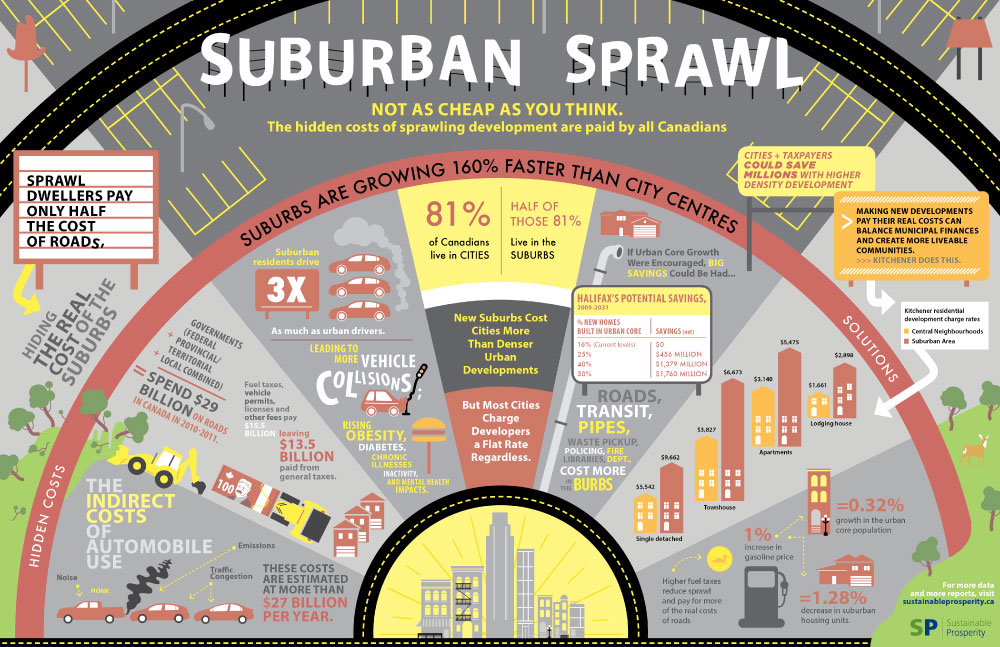 It’s a Canadian study on the hidden costs of suburban sprawl and it reveals the economic stress sprawl puts on all citizens, both those inside and those outside of the city:
 the walking green